
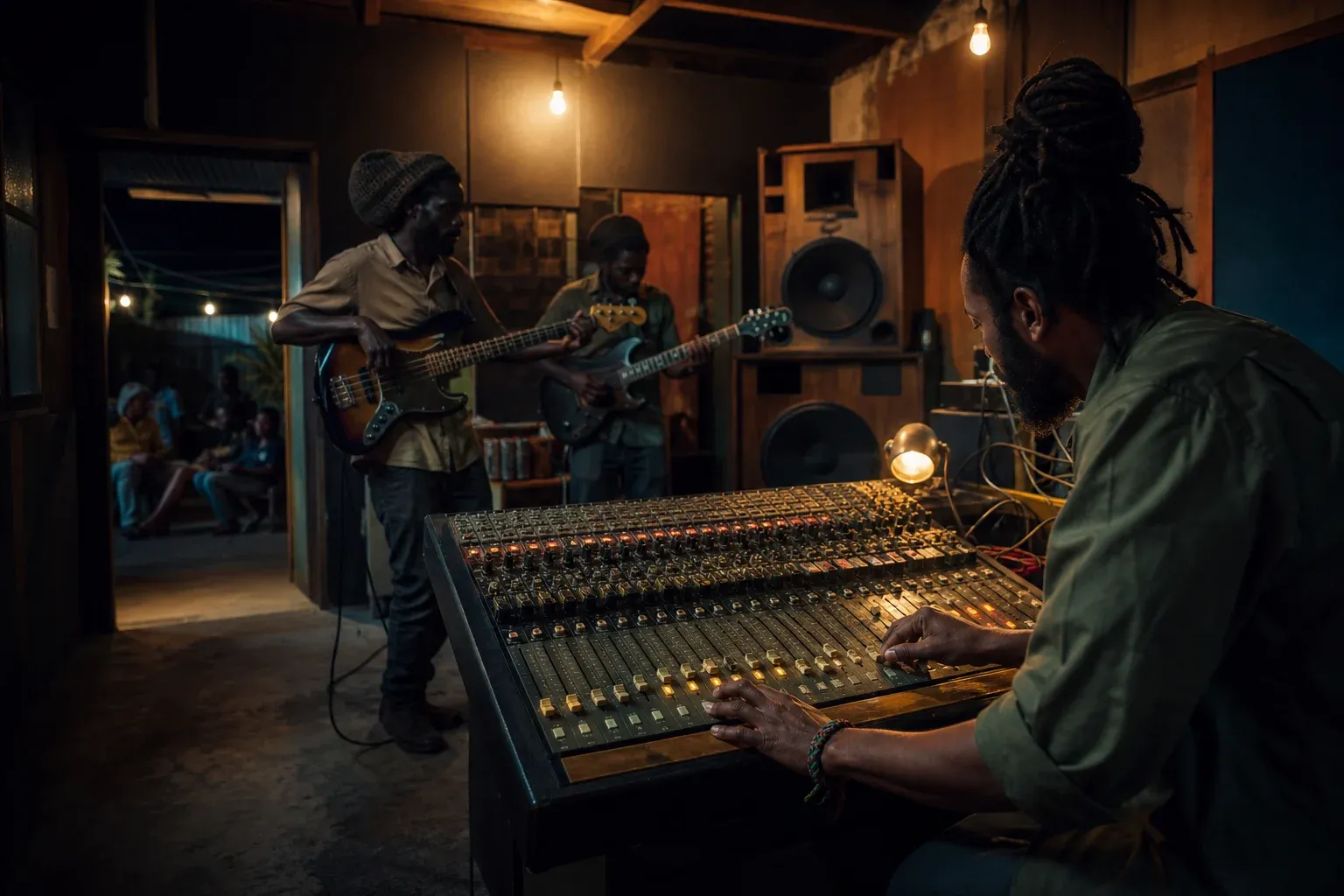
Dub is sometimes introduced as reggae with heavy echo. That description identifies an audible surface but misses the working method. A dub mix begins with a recording whose parts can be reconsidered. The mixer removes a vocal, exposes the rhythm section, drops an instrument into silence, or sends one snare hit into an effect. The resulting record is not simply the original with more ambience. Its arrangement is performed again.
The method developed within Jamaica’s recording and sound-system economy. Producers, engineers, musicians, singers, and deejays did not occupy identical roles, and accounts of dub’s origin should not compress their work into one inventor story. Osbourne “King Tubby” Ruddock is central to the development of dub mixing, while producers and engineers including Lee “Scratch” Perry, Errol Thompson, and others developed distinct ways of rebuilding recorded rhythms. Sound On Sound’s practical history places Tubby’s work in late-1960s Jamaica and describes the mixing board as the dub performer’s instrument. 1
The rhythm existed before the dub mix
A reggae session usually supplied more than a finished vocal record. Its rhythm track could support another singer, an instrumental release, or a deejay performance. This reuse was practical, but it also changed how people listened to the recording. Remove the lead vocal and the hierarchy shifts. Bass and drums become the main argument. Guitar, piano, or organ strokes stop behaving like continuous accompaniment and become events placed around the rhythm.
That is why subtraction matters as much as effects. Muting a channel changes the arrangement immediately. If the harmony instruments disappear, the bass line has more room to define pitch and direction. If the kick drops out while the bass continues, the listener feels the missing impact even though the pulse remains implied. When the missing part returns, its entrance has been prepared by absence.
Sound On Sound describes creative muting as a way to build a new backing structure without rewriting the source song. The mixer must anticipate the beat because a mute performed slightly late leaves an unwanted attack at the start of the gap. 2
A version kept the recording open
The word version refers to an alternative use or treatment of an existing rhythm. Versions were connected to singles, sound systems, and the repeated use of successful rhythm tracks. They could leave room for a deejay, emphasize instruments, or become the basis of a more radical dub mix.
This practice resists a simple modern distinction between composition and post-production. The source performance mattered, but the recording remained available for further musical decisions. A fader move could determine structure. An effect return could create a new response to a vocal fragment. The mix was an active stage rather than a neutral report on what musicians had already played.
Lee “Scratch” Perry’s Black Ark work demonstrates how strongly this approach depended on listening and routing rather than on a large inventory of equipment. Interviews and profiles identify a modest multitrack setup, effects, and a working method built around layering, commitment, and repeated transformation. Perry’s own explanations are often metaphorical, so gear lists should not be treated as a complete recipe for his sound. 3 4
Sound systems made recorded music situational
The studio is only half of dub’s early history. The other half is the sound system: a mobile musical organization built around records, amplification, selectors, microphones, and a public dance. Jamaican sound systems developed before dub, and their competitive practices shaped what studios were asked to supply. A record was tested in a room full of people, through speakers capable of making its bass physically obvious. Exclusivity mattered. A selector who could play a recording unavailable to a rival possessed more than a rare object; the recording could identify the sound itself.
Norman Stolzoff’s study of dancehall treats the sound system as an institution rather than a stack of equipment. Owners, selectors, deejays, engineers, record producers, and audiences occupied connected roles. The dance was a place where new records acquired meaning and where demand could return to the studio. This circulation helps explain why a mix prepared for a particular system was not merely a promotional copy. It could be a tailored performance resource. 6
David Rodigan’s account of cutting dubplates at King Tubby’s studio makes the process concrete. The multitrack tape was played while a fresh mix was performed and cut. After a vocal pass, another run could produce the version needed for a deejay to talk over. The procedure joined studio time, live judgment, and a physical disc in one sequence. There was no expectation that every decision would later be recalled from automation. The mix had to work as it happened. 7
A dubplate is therefore different from a normal commercial pressing even when the music later overlaps with a released version. It is an acetate cut in small quantity, often as a unique or pre-release recording for a sound. Acetates wear more quickly than mass-made vinyl, which reinforces their status as working objects rather than permanent editions. The value lies in who can play the selection, whose name the singer may voice in a special, and what happens when it is heard against another sound’s material.
This context changes how studio effects should be interpreted. Echo was not added only to make a headphone image seem large. A sudden repeat could redirect attention across a dance. A bass drop could make the system’s return feel larger. A few exposed drum hits could give a deejay room to speak. The mixer was preparing recorded relationships for public use.
The B-side was a laboratory, not an afterthought
Accounts of Jamaican popular music repeatedly connect the growth of versions with the two-sided single. A vocal or instrumental title on one side could be paired with an alternative treatment on the other. The practice economized on a successful rhythm, but economy alone does not explain the range of results. Reuse made comparison ordinary. Listeners could hear what remained when the singer vanished, how another performer occupied the same backing, or how a mixer altered the balance of familiar parts.
Michael Veal describes an economy in which one session could yield a song, deejay treatments, and dubs. His account joins business practice to close musical analysis. A rhythm was valuable precisely because it was not exhausted by one issue. Each subsequent treatment could reveal a different internal design. 8
That openness did not erase authorship. Session musicians devised bass lines, drum patterns, guitar strokes, keyboard parts, and horn arrangements. Singers and songwriters provided melody and text. Producers organized sessions and owned or licensed recordings. Engineers determined how captured parts reached tape and how they could later be recombined. Label credits did not always document those contributions clearly, and later reissues can compound the problem by assigning a dub mainly to the best-known producer.
For that reason, phrases such as “the producer made the track” require care. In Jamaican usage the producer could be a financier, session organizer, repertory judge, label owner, and creative director, without necessarily operating the console. The engineer who performed a dub mix might be named prominently, named informally, or omitted. The musicians whose rhythm made the transformation possible might appear only in later discographical research. David Katz’s oral history is valuable here because testimony from participants exposes both collaboration and disagreement. Memory does not remove uncertainty, but it prevents one celebrated name from absorbing a whole studio network. 9
Kingston studios offered different possibilities
“The Jamaican studio” is too broad a category. Federal, Studio One, Treasure Isle, Dynamic Sounds, Randy’s, Channel One, King Tubby’s home studio, and Lee Perry’s Black Ark differed in rooms, consoles, recorders, staff, clientele, and period of operation. Tracks also moved between facilities. A rhythm could be recorded in one studio, voiced in another, and mixed somewhere else. The path matters because no single room contained every stage of the record.
Studio One, led by Clement “Coxsone” Dodd, built a deep rhythm catalog through recurring work with musicians and arrangers. Treasure Isle, associated with Duke Reid, was central to ska and rocksteady recordings whose rhythms later remained available for versioning. Dynamic Sounds offered larger commercial facilities. Channel One became closely associated in the 1970s with the Revolutionaries and with a drum sound whose sharper attack suited emerging rhythmic changes. These are not interchangeable entries in a gear list. Each studio linked particular people and habits.
King Tubby’s facility grew from Ruddock’s knowledge of electronics and sound systems. The often-repeated story of dub as a poor studio accidentally discovering effects understates that expertise. Building, repairing, and modifying amplifiers required practical command of signal flow. The same way of thinking applies to a mixer: a signal has a source, a route, a level, a destination, and possible return paths. Tubby’s achievement was not ignorance used creatively. It was technical knowledge directed toward a new musical problem. Lloyd Bradley places this work within the social world of Kingston’s sounds, record production, and neighborhood competition. 10
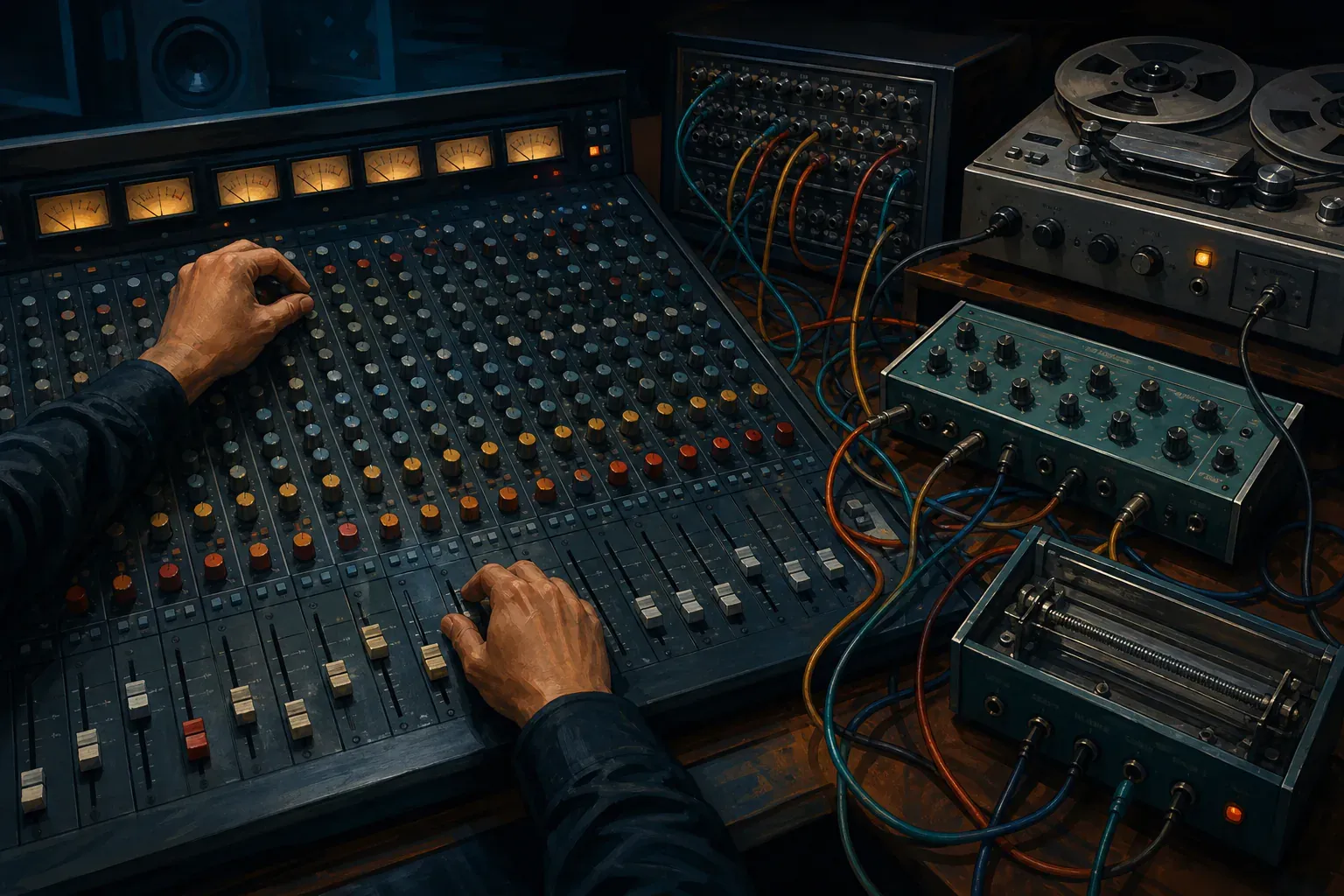
The MCI console installed at Tubby’s is central to descriptions of the classic method. David Katz’s technical history identifies a 12-input, four-bus desk acquired after Dynamic Sounds upgraded. Individual channels could be removed, assigned, equalized, and sent to effects while the four-track source ran. A custom high-pass filter became an expressive device when swept across the program. The transformation depended on the desk’s limits: with several instruments already combined on one tape track, muting could remove a group rather than an isolated modern stem. 11
Four tracks encouraged decisions by families of sound
A contemporary digital session may display a separate track for every drum microphone, vocal layer, guitar overdub, and effect return. Early dub often began from much coarser groupings. A four-track tape might hold drums on one track, bass on another, a collection of harmony instruments on a third, and vocals or horns on the fourth, although actual allocations varied. The mixer could not always retrieve a single instrument once several had been committed together.
This constraint shaped form. Pulling down the vocal group could expose the rhythm, but pulling down a combined guitar-and-keyboard track might remove the entire offbeat pattern. Bringing it back restored a block of rhythmic information. The resulting arrangement can sound bolder than a modern session in which dozens of tiny elements are adjusted individually. One fader changes the status of a whole family of sound.
Bouncing parts during recording made those families more permanent. Once several sources were mixed onto one tape track, their internal balance could not be revised during the dub. Commitment moved upstream. Musicians, recording engineer, and producer therefore had to create a rhythm robust enough to survive reduction. Leakage, saturation, room sound, and tape noise were not independent plug-ins. They belonged to the recorded material that reached the dub mixer.
The limitation should not be romanticized. More tracks solve real problems, and Jamaican studios adopted expanded formats when budgets and facilities allowed. What the four-track method demonstrates is narrower: fewer controls did not mean fewer musical decisions. It concentrated decisions at the boundaries between grouped parts.
- 1Multitrack families
- 2Console channels
- 3Aux send
- 4Echo or reverb
- 5Return channel
- 6Stereo or mono master
The return comes back to a controllable channel, so the mixer can mute, filter, or resend it.
The mixer performed negative space
Subtraction is easy to describe and difficult to execute. Muting after a note begins leaves an attack. Opening a channel late removes the start of a word or chord. A fader move has to anticipate musical time, just as a player anticipates an entrance. The engineer listens ahead while also judging what is currently sounding.
Different silences do different work. Removing the bass for half a bar weakens the tonal floor; its return can reorganize the room. Removing the kick while leaving bass makes the pulse less explicit without eliminating low pitch. Removing the snare temporarily erases the backbeat. Removing harmony makes the key less certain. Removing the vocal turns words into remembered structure: a listener familiar with the song may continue to hear the absent phrase internally.
This is why a dub cannot be understood from an inventory of effects. Two mixes can use the same delay and reverb but organize absence differently. One may retain a stable drum and bass bed under occasional echoes. Another may fracture the rhythm into isolated events, allowing several beats of near-silence. Veal’s phrase “shattered songs” names this capacity without suggesting randomness. The fragments still derive force from the song and rhythm listeners know. 12
Try mapping a dub without naming instruments. Draw a line for continuous sound and leave gaps where the arrangement thins. Mark each return. The page reveals whether the mix builds regular eight-bar contrasts, responds to vocal phrases, or follows a less predictable performance logic. Then repeat the exercise for bass, drums, harmony, and voice separately. The comparison makes the mixer’s timing visible.
Delay made time playable
A delay stores a signal briefly and plays it back later. In a conventional mix, the delay may remain at a stable level throughout a section. A dub mixer can treat the send and return as performance controls. One word, chord, or drum hit enters the delay; the dry channel disappears; the repeats continue on their own.
The timing of those repeats matters. A repeat that relates clearly to the pulse can create a second rhythmic pattern. Filtering the return changes successive echoes, often removing high frequencies so that later repeats feel less direct. The delay is no longer a background coating. It answers the source.
Delay time writes a second rhythm
Delay is easiest to hear as a copy, but its musical effect depends on placement. Suppose a snare sounds on beats two and four. A repeat one eighth note later creates an answering attack between the main beats. A dotted-eighth delay places successive copies three sixteenth notes apart, so the repeated figure crosses the beat differently. A triplet setting creates another grid. Early hardware did not necessarily offer a button labeled with those note values. The operator set time by ear, and small departures from a strict tempo grid became part of the pattern.
Tape delay makes the relationship physical. A record head puts signal on moving tape and a playback head retrieves it farther along the path. Tape speed and the distance between heads determine the interval. Change the speed and the delay time changes; the pitch of material already circulating can bend as well. Repeated passes soften transients, add noise, and alter frequency response. An echo from tape is not a transparent duplicate.
The Roland Space Echo became one well-known route to delay and feedback, although it should not be projected backward onto every early dub. Katz’s technical account distinguishes equipment used at different dates and notes that dedicated units became part of the expanding palette. The larger point is the return path: whatever the device, the repeat could come back to a channel, be equalized, and be sent onward again. 13
Listen first for the interval between source and repeat. Ignore tone. Tap the main pulse and ask where the first echo lands. Then follow only the repeats. Do they keep the same spacing, or does a hand movement alter the time? Do they fade smoothly, disappear because the return is muted, or grow because feedback rises? This separates three decisions often mistaken for one effect: when the copy arrives, how its level changes, and how long the loop remains open.
Sending is an act of selection
An auxiliary send splits some of a channel’s signal toward an effect. The dry sound can remain in the main mix while the effect output returns elsewhere. That routing allows one snare strike to enter a reverb or one vocal fragment to enter an echo without processing the entire mix. The selectivity is fundamental to dub.
If a send remains open continuously, every hit produces a tail. Dense repetition soon fills the gaps that make the rhythm legible. If the send is opened for one event and then closed, the chosen event continues while later dry events pass untouched. The engineer has effectively separated one moment from a performance already recorded to tape.
This gesture creates a new kind of emphasis. Conventional emphasis might make a note louder. A dub send can make it longer, move it backward in depth, give it several rhythmic answers, or allow it to remain after its source channel is gone. The selected fragment acquires a temporary life outside the track from which it came.
On a digital workstation, recreate the method with restraint. Put the delay on a return track rather than inserting it directly on every source. Keep the return under a fader. Perform the send for isolated words, rimshots, or chords. Then mute the dry source after the send. An insert that processes the entire channel does not create the same independence between source and tail.
Feedback changed the life of a repeat
Feedback routes part of a delay’s output back into its input. At a low setting, the effect produces a few diminishing repeats. Increase the return and each repeat feeds the next more strongly. The sound may continue much longer, change tone as it passes through the circuit, or approach instability.
In the dub method described by Sound On Sound, the delay returns to a full mixer channel that can itself be sent back to the delay. This gives the mixer direct control over the feedback loop. The move requires care because the level can grow rapidly. That risk is part of why the result feels performed rather than recalled from a preset. 5
Feedback near the edge of stability behaves differently from a fixed series of echoes. The loop stores energy. A small fader movement can change a decaying phrase into one that holds its level or begins to build. The operator has to hear the trend before it becomes overwhelming. Pulling the return down stops the audience from hearing the loop, while reducing the feedback send changes what remains inside it. Those are separate controls.
Filters make the loop easier to manage and more articulate. Removing low frequencies prevents bass energy from accumulating until each repeat obscures the rhythm section. Reducing high frequencies makes later repeats less sharp. A band-limited return occupies a smaller spectral space than the dry source and can remain audible without competing with it at every frequency.
King Tubby’s sweeping high-pass treatment is more dramatic. As the cutoff rises, bass and lower midrange disappear, leaving increasingly thin remnants. Moving it downward restores weight. The effect is sometimes imitated with an automated filter sweep, but the original gesture belongs to a live sequence of decisions: when to begin, how fast to move, where to turn, and which channels are present while the spectrum changes.
Reverb turned one hit into a room
Reverb behaves differently from a clearly separated echo. It combines many reflections into a denser tail. In a dub mix, a reverb send can be moved for a single snare hit or short instrumental accent. The dry hit begins close to the listener, then its tail suggests a much larger surrounding space.
The important change is not simply that the hit lasts longer. Its apparent distance and scale change. A bright, short treatment can suggest a hard nearby surface. A darker, longer tail can push the event behind the rhythm section. Because the send is performed selectively, the imagined room can appear for one moment and vanish before the next bar.
Springs and plates do not describe real rooms literally
A spring reverb sends an electrical signal through a driver that excites metal springs; a pickup converts their vibration back into an electrical output. A plate reverb excites a suspended metal sheet. Neither device records an acoustic room. Each produces a dense pattern of energy that listeners interpret as spatial extension. Springs can splash and emphasize resonances, while plates commonly supply a smoother bright tail.
Dub practice exploited those signatures rather than hiding them. Katz records the famous percussive crash associated with striking a spring unit at Tubby’s. The sound is not a simulation of a naturally occurring hall. It exposes the mechanism and turns the effect device into a struck instrument. 14
This distinction matters because studio space is constructed. A snare may have been recorded in one room, sent through an electromechanical reverb that implies another, and heard through loudspeakers in a dance that adds a third. The record does not preserve one stable environment. It layers spatial cues that can contradict one another.
Reverb also changes rhythm. A tail that extends beyond the next beat connects events that were separate in the dry performance. If low frequencies enter that tail, the mix can lose clarity quickly. Sending mainly rimshots, voice fragments, guitar skanks, or horns keeps the bass foundation comparatively dry and readable. Selective reverb is an arrangement choice as well as a spatial one.
Equalization became moving orchestration
Equalization is often taught as correction: remove a resonance, reduce competition, or compensate for a microphone. In dub it can be foreground action. A broad movement through the midrange changes which part of a composite track dominates. A high-pass filter can strip a full rhythm to brittle percussion and upper harmonics. A low-pass movement can make the record seem to close around the bass.
These changes resemble orchestration because frequency bands carry different musical information. The lowest region may contain the bass fundamental and kick weight. The low midrange carries body but can accumulate mud. Upper midrange clarifies the attack of guitar, voice, horns, and snare. High frequencies contain cymbal edge, tape hiss, and the bright onset of reverberation. Moving a filter redistributes attention among those functions even when no fader changes.
The effect depends on what was grouped to tape. Filtering a drum submix alters kick, snare, cymbals, leakage, and room together. Filtering a harmony track may move guitar and keyboard as one object. Modern demonstrations that sweep a filter across the stereo bus can approximate the global sensation but miss the interplay between separately routed groups.
Compression prepared impact for the sound system
Compression reduces level according to a threshold and ratio, with attack and release controls shaping how quickly gain reduction begins and recovers. It can restrain peaks, increase average level, or change the apparent envelope of drums. On a stripped dub mix, the absence of voice and harmony leaves more room for bass and percussion to drive the cut, but mastering still has to respect the physical limits of the disc and playback chain.
Katz notes hard compression as part of the explosive character heard on several classic Tubby mixes. That observation should not become a universal recipe. A fast attack can flatten the beginning of a drum hit; a slower attack may let the transient through before gain reduction clamps down. Release that recovers in relation to the groove can make the track breathe. 15
Do not confuse loudness with bass extension when comparing editions. A modern reissue may have a different transfer, equalization, limiting, or source tape from an original single. Level-match before deciding that one mix has more bass. Then compare the bass line’s pitch definition, the kick’s onset, and how long low notes remain after the attack.
Tape made every reuse a generation
Analog tape stores a continuously varying magnetic representation. Recording level, tape formulation, machine alignment, speed, head condition, and the number of copying stages affect the result. Saturation rounds peaks and introduces distortion when the medium is driven. Hiss remains audible when sparse arrangements expose the background.
Version culture multiplied encounters with tape. A rhythm might be recorded, bounced, copied, voiced, mixed, and transferred for cutting. It is rarely possible to reconstruct every generation from the sound alone. Nor should all roughness be attributed to a deliberate lo-fi aesthetic. Some artifacts arose from work, wear, copying, or available maintenance; others were exploited once heard.
Lee Perry’s Black Ark is often discussed through both limited track count and dense overdub practice. Katz’s guide dates the home studio’s construction to late 1973 and notes that early work could still involve voicing elsewhere while the room was becoming fully operational. The chronology prevents the studio’s mythology from swallowing the actual movement of tapes and performers. 16
Perry could build density before the dub stage through percussion, voices, instrumental overdubs, and committed effects. Reduction then reveals and conceals parts of an already layered recording. This differs from a sparse rhythm merely decorated with echo. Both can produce dub, but the source material offers the mixer different kinds of internal pressure.

Regional and historical differences remain important
Dub’s techniques travelled widely, but the Jamaican context should not be reduced to a universal plug-in style. British post-punk, electronic dance music, hip-hop production, ambient music, and many later bass cultures drew on parts of dub practice under different social and technical conditions. Similar use of delay does not make every spacious production a dub record.
Listen for a relationship rather than an isolated effect. Which parts are allowed to carry the rhythm? What disappears? Does an echo answer a single event or remain present throughout the mix? Does the engineer treat the recorded material as fixed, or as a set of parts that can still be performed? Those questions lead closer to dub’s method than the presence of reverb alone.
Dub travelled as a method, not a fixed preset
Dub moved beyond Jamaica through records, migration, touring musicians, engineers, and sound-system practice. Britain was especially important because postwar Caribbean communities had already built spaces in which Jamaican records could circulate on their own terms. Local sounds, shops, labels, broadcasters, and clubs did more than import a finished genre. They created new conditions for producing and hearing bass-led music. Dick Hebdige’s account of Caribbean music in Britain connects those musical practices to questions of identity and cultural translation. 17
British reggae producers and performers developed their own approaches to dub. At the same time, punk and post-punk musicians encountered Jamaican records and studio methods. That exchange produced results ranging from respectful collaboration to superficial borrowing. The presence of an echo send or a version on a single does not establish equal knowledge of Jamaican practice. Credit, payment, access to studios, and the public story told about innovation remain part of the comparison.
Paul Sullivan follows dub’s movement through British bass culture, electronic music, and later production. His diaspora framework is helpful because it avoids treating influence as a single arrow from one famous Jamaican engineer to the rest of the world. Techniques were carried by people and institutions, then altered by local equipment, venues, and musical priorities. 18
Hip-hop offers a related but distinct history. Jamaican-born Clive Campbell, known as DJ Kool Herc, brought experience of Jamaican sound culture into Bronx parties, but early hip-hop developed through American funk and soul breakbeats, local MC practice, turntablism, electricity borrowed from neighborhood infrastructure, and the social life of the Bronx. Saying that dub “invented hip-hop” collapses those histories. It is more accurate to identify shared attention to powerful amplification, versions of recorded material, microphone performance, and the creative reuse of records while preserving the differences between Kingston and New York.
Later electronic genres adopted delay feedback, sub-bass, sparse arrangement, remixing, and the foregrounding of production. Techno, ambient, jungle, drum and bass, trip-hop, dubstep, and many experimental scenes contain audible encounters with dub, but not every example uses all of those traits. Influence is strongest when musicians and producers describe a chain of listening, collaboration, sampling, or scene contact, rather than when a critic works backward from any deep bass line.
This distinction protects dub from becoming a vague synonym for spacious electronic music. A plug-in preset can reproduce a filtered echo. It cannot reproduce the Jamaican record economy, the labor of a session band, ownership of a master tape, a selector’s need for exclusive material, or an engineer’s one-pass performance. The sound travels more easily than the whole system that gave the sound meaning.
Credit the network without erasing individual work
Dub histories often swing between two errors. One assigns invention to a single heroic figure. The other responds by making every contribution interchangeable. King Tubby’s technical and musical work was specific. Lee Perry’s productions at the Black Ark were specific. Errol Thompson’s mixes, Augustus Pablo’s productions and melodica, Scientist’s later work, and the playing of recurring session musicians cannot be folded into a vague collective without losing audible differences.
The Los Angeles Times obituary assessment of Perry emphasizes his international impact and his transformation of recorded sound, but celebrity profiles naturally center their subject. Read them beside interviews, discographies, technical histories, and accounts of the musicians around the session. 19 A famous producer’s biography can establish dates and working relationships while still leaving individual rhythm tracks under-credited.
Credits are complicated further by alternate titles, repressings, licensing, and records issued in different territories. The same rhythm may appear under several artists’ names or on compilations assembled long after the session. Label copy can contain misspellings or omit the mixing engineer. A careful listener should therefore treat a confident online track list as a lead, not final proof. Matrix numbers, contemporary labels, musician testimony, specialist discographies, and reissue notes can be compared, and disagreement should remain visible when it cannot be resolved.
Political interpretation needs the same discipline. Reggae and Rastafari have often been filtered through journalism and marketing that treats Jamaica as a source of rebellious atmosphere rather than a society with specific religious, class, and political conflicts. Stephen King and his coauthors examine how reggae was represented and managed in public discourse. Their work warns against turning every studio effect into a simple symbol of resistance. 20
Dub can interrupt the stable voice of a song, expose its material construction, and make space behave unpredictably. Those qualities invite political readings, especially within histories of colonialism and diaspora. They do not make interpretation automatic. A claim about politics needs evidence from lyrics, production context, artist statements, distribution, reception, or a combination of them. Echo by itself has no fixed ideology.
A final listening sequence
Choose one vocal record and a documented dub or version made from the same rhythm. Begin with the vocal and write down the bass phrase, the main drum accents, and two harmony events. Do not describe effects yet. This establishes the material that was available for transformation.
Play the version next. Mark the first disappearance and the first return. Identify whether the change was made with a fader, an edit, or an effect as far as the recording allows you to hear. Then follow one sent event through its complete life: dry attack, first repeat, later repeats, filtering, and disappearance. Repeat the exercise for one reverberant hit.
On the third pass, ignore isolated sounds and follow section length. Does the mixer retain the song’s verse-and-chorus proportions, create new blocks, or make changes at irregular points? On the fourth, listen to the background. Tape hiss, leakage, effect noise, and abrupt gates reveal moments when the arrangement becomes unusually sparse.
Finish by returning to the vocal record. Details that seemed like accompaniment may now sound structural because the dub demonstrated how much force their removal carries. This is the central listening lesson. Dub did not merely place effects on reggae. It made the recording’s internal relationships available for another performance.
Score: a bass phrase built around absence

Source details follow the article.