
The riff is a timing system
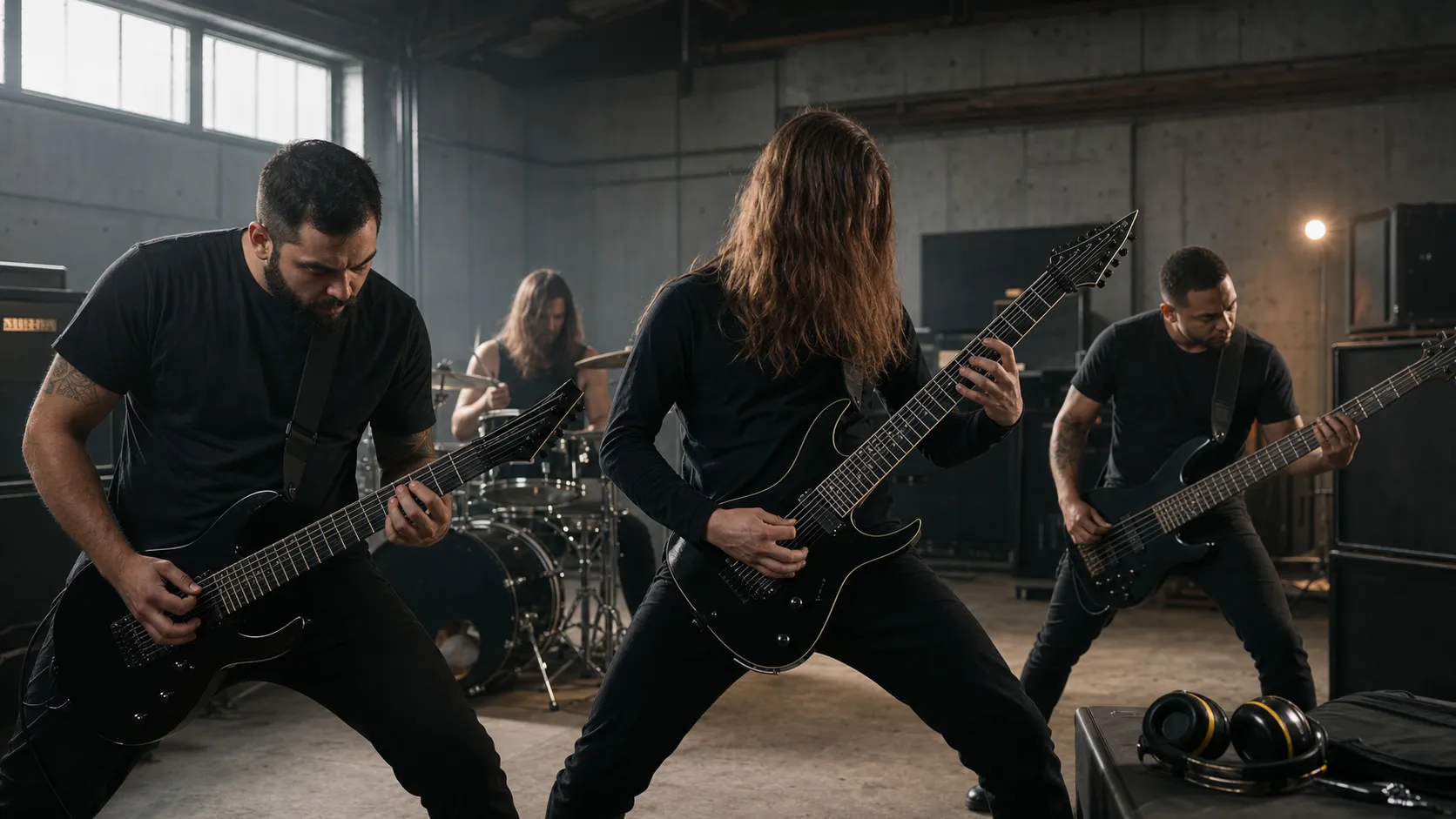
A riff is recognizable as a sequence, but in metal that sequence often governs more than guitar. Kick drums may double selected attacks. Bass can reinforce the same pitches or fill the spaces between them. Vocals may phrase across the pattern rather than follow a regular chord loop. When the riff changes, the whole arrangement can change with it.
Metal developed from heavy rock lineages associated strongly with Birmingham and Black Sabbath, then divided into scenes with different rhythmic priorities. 1 Traditional metal, doom, thrash, death, black, groove, power, and progressive metal do not share one default tempo or guitar technique. The useful common question is how repeated figures organize time.
Find the smallest pulse
Tap the main beat, then listen inside it. A riff may divide each beat into two eighth notes, four sixteenths, triplets, or a mixed pattern. The notes need not land on every subdivision. Rests make the grid audible by withholding expected attacks.
Try vocalizing the rhythm on one syllable without naming pitches. If the pattern remains recognizable, articulation is carrying much of its identity. This is why one low note can support an entire riff when its attacks and gaps are arranged precisely.
Odd meters are only one source of irregularity. A riff in common time can cross the bar line, group sixteenth notes unevenly, or repeat after a length that conflicts with the drum phrase. Count the drums and guitar separately before deciding that the meter itself has changed.
Palm muting controls duration
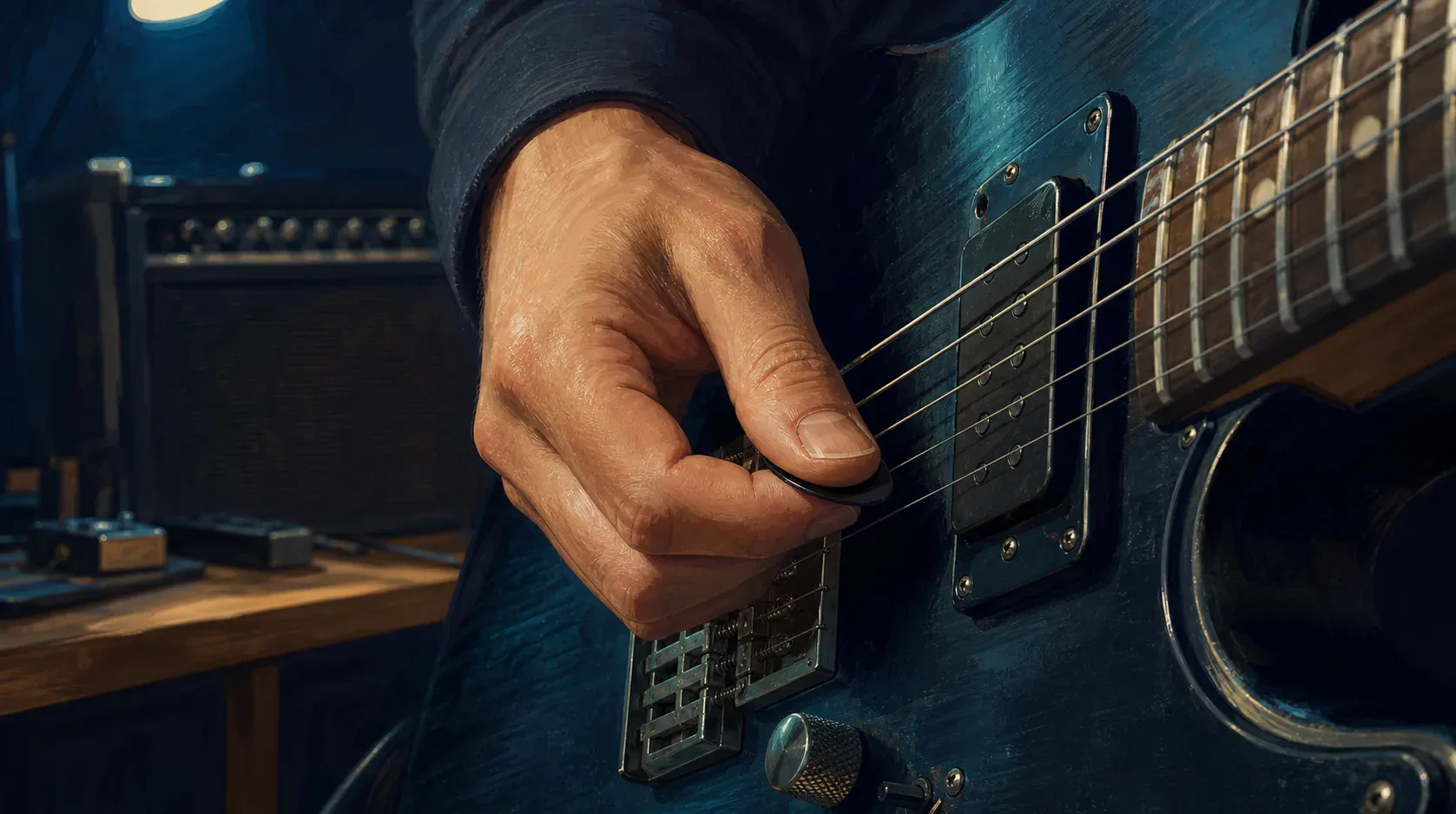
Palm muting places the picking-hand edge near the bridge so the string stops resonating freely. The pitch remains, but the note becomes shorter and its attack more prominent. Moving the hand slightly changes how much low-frequency body and high-frequency pick noise remain.
Alternating muted and open notes creates contrast without changing amplification. An open chord after several clipped attacks seems larger because its sustain enters newly available space. The effect is arranged, not added afterward by a “heavy” preset.
The hand position is a continuous control, not a switch. Rest too far onto the speaking length and the note loses a stable pitch. Move behind the saddles and it rings freely. Players learn a narrow region where the low string stays pitched but decays quickly. Pick angle and depth then change the transient: a shallow stroke can stay quick, while a deep stroke adds resistance and may pull timing late. These details explain why two players using the same guitar, tuning, and amplifier can produce riffs with different weight.
Drums decide what the riff weighs
When kick drum and guitar coincide, their transients combine. A double-kick pattern can trace every guitar note, select only structural accents, or establish a faster layer beneath longer chords. Snare placement then tells the listener which attacks belong to the larger groove.
In slower metal, space between hits allows cymbal decay, amplifier sustain, and room sound to become part of the rhythm. In fast styles, the contrast may occur between continuous picking and half-time snare placement. Tempo alone therefore says little about perceived weight.
Bass can follow guitar closely, but exact doubling is not compulsory. A sustained bass note can stabilize a moving guitar figure. A bass run can connect two riff shapes. Production sometimes hides these choices because dense guitars occupy the same low-mid range; isolating the bass reveals whether it is reinforcement or counter-line.
Low tuning is a change of range
Downtuning lowers one or more strings. It gives access to lower pitches and changes string tension unless gauge or scale length compensates. The player may respond with different picking pressure, muting, and vibrato. These physical changes affect the sound, but low tuning does not automatically supply clear rhythm.
A poorly articulated low riff can become indistinct under high gain. Less distortion sometimes produces a larger recorded result because pick attacks, pitch centers, and separate guitar takes remain readable. Sound On Sound specifically recommends reducing gain when doubled distortion begins to accumulate into harshness or lost definition. 3
Double tracking changes the edge
Metal rhythm guitars are often recorded as two separate performances and panned apart. Sound On Sound distinguishes this from simply duplicating one take and describes quad tracking as four separately performed parts. 2 Small differences create width and thickness. Large differences weaken the riff.
Use the guitar workbench to compare one side with both takes. With one guitar, the center and pick attack are obvious. With both, the image expands and tiny disagreements appear at the edges. Add drums and bass last. The full result may feel more controlled even though it contains more variation.
Hear sections as transformations
A breakdown is not merely a slow passage. It can reduce note count, relocate accents, move the snare to half time, or turn an earlier figure into a more exposed pattern. A chorus may open palm-muted notes into sustained chords. A transition can keep the pitches but change subdivision.
Map one song by writing only “dense,” “open,” “muted,” and “sustained” beside each section. Then repeat the exercise for drum density. The combined map explains more about the arrangement than a list of guitar tunings.
Metal’s many scenes use these resources differently. Precision, abrasion, swing, mechanical repetition, and unstable tempo can all be deliberate. Hear the mechanism first; apply the subgenre name after the evidence is audible.
How attacks become harmony and form
Riff analysis begins with attacks because distortion complicates pitch. A power chord contains a root and fifth, often with the root doubled at the octave. High gain adds overtones and intermodulation products, so a tightly voiced low chord can occupy more spectral space than its notation suggests. Lilja’s study of classic heavy-metal harmony shows why modal and chromatic relationships need to be heard through riffs rather than forced into a four-part chord model. [#lilja-metal] Write the lowest pitch of each attack first. Add upper chord tones only after the repeating path is clear.
A pedal tone creates continuity while other pitches move around it. The open lowest string is mechanically convenient, but convenience becomes style when alternating fretted notes form a recognizable contour. Mark the pedal attacks and the changing notes with different symbols. The ratio between them changes perceived stability. Eight pedal attacks around two moving chords feels grounded; two pedal attacks between long chromatic shapes feels more directional. Neither requires a different meter.
Rests are harmonic events because they remove masking and let previous sound decay. A quarter-note silence after a dense figure exposes cymbal tail, room, vocal breath, and amplifier noise. When the band stops together, listeners perceive the boundary before the next pitch arrives. Pillsbury’s study of Metallica treats recorded sound, musical detail, and identity together, a useful reminder that precision is not separable from the meaning players and audiences assign to it. [#pillsbury-metal]
Riff length can disagree with bar length. A five-eighth-note cell repeated over common time will begin at different positions until the cycles meet. Do not label that polymeter automatically. First decide whether musicians and drummer sustain a four-beat reference while the guitar cell rotates, or whether the ensemble accents a changing meter. Clap the snare pattern alone, then speak the riff attacks. If each remains stable while their alignment changes, the listener is tracking two cycles.
Tempo changes the amount of acoustic information between attacks. At a slow tempo, a muted note may still have a clear decay, and an open chord can reveal beating between guitar takes. At high speed, individual decays overlap and pick noise may define the subdivision more clearly than fundamental pitch. Berger’s ethnography emphasizes musicians’ situated experience of musical sound rather than treating metal as a list of objects. [#berger-metal] The Wesleyan publisher account likewise describes interviews and fieldwork across metal, hard rock, and jazz scenes. [#wesleyan-berger] A useful analysis therefore asks what performers attend to: resistance under the hand, a drummer’s body cue, cabinet response, and the sensation of a repeated cycle landing.
Formal function follows these relationships. An opening riff can establish the song’s smallest pulse; a verse can remove its final accent to make room for voice; a pre-chorus can lengthen notes without changing pitches; a chorus can retain rhythm but widen the voicing. A breakdown may expose the attack map at half the cymbal density. Describe each transformation in verbs: removes, sustains, doubles, displaces, compresses, or extends. Moore’s method for analyzing recorded popular song supports attention to the recording as the heard work, not merely a score behind it. [#moore-song]
- 1Count sixteenths
- 2Mark attacks
- 3Mark rests
- 4Follow kick support
- 5Locate the repeat boundary
Accents can cross the beat while the underlying subdivision remains steady.
Recording precision without flattening the performance
Start at the source. String gauge, scale length, tuning, pick material, and setup affect how predictably a low note returns after an attack. Fret buzz may provide desirable percussion, but uncontrolled pitch rise from pressing too hard can make doubled takes sound sour. Huber and Runstein’s recording handbook treats microphone choice and signal path as parts of a larger production decision. [#huber-recording] Capture a clean DI when practical, not because it is automatically better, but because it preserves a timing and pitch reference and can feed later reamping.
An electric-guitar cabinet is not a full-range source. Speaker position, cabinet edges, floor reflection, and microphone distance shape the recorded spectrum. The AES paper on electric-guitar recording documents measurable interactions, including reflection and comb-filter effects that complicate folklore about a single correct microphone point. [#aes-guitar] Move one variable at a time. Compare the microphone at the center and edge of the cone, then alter distance. A position with slightly less fizz may accept layering better than the most exciting soloed tone.
Record the first take through the whole song before chasing a perfect pair bar by bar. The player needs a complete map of breath, pick fatigue, section transitions, and noise control. For the second take, preserve guitar setup and monitoring balance unless a deliberate tonal contrast is wanted. Sound On Sound’s modern-metal guidance stresses that double and quad tracks are separate performances. [#sos-modern-metal] Copying the first file cannot create the changing onset, tuning, and articulation differences that make two takes spread naturally.
Editing should protect rhythmic grammar. Choose a reference: drums, a trusted guitar take, or the intended grid. Repair an attack that obscures a unison stop, but do not move every waveform edge to the same sample. The ear tolerates and often values small differences until they disguise the pattern. Edit note endings as carefully as starts. A late mute can fill a written rest and make the entire band seem less precise even when the next attack is aligned.
Gain accumulates. A single guitar may sound satisfying with more saturation than a pair can carry. Sound On Sound advises reducing distortion when layers become harsh or lose definition. [#sos-epic-guitars] Senior’s mixing guidance similarly favors decisions made in context rather than impressive solo settings. [#senior-mixing] Bring bass and cymbals back before adding upper-mid EQ. What sounded thin alone may be the layer that leaves space for pick definition and vocal consonants.
Hard panning makes timing disagreement visible at the sides. Listen alternately to left, right, stereo, and mono. A mono collapse does not make separately performed guitars identical, but it reveals whether their combined midrange masks bass or snare. The Sound On Sound metal mix case shows practical use of limited widening and mono checks to control comb filtering. [#sos-mix-metal] Do not “fix phase” between independent performances as if they were two microphones on the same event; their relationship changes on every note.

Practice: build and audit one riff
Set a metronome between 90 and 120 beats per minute and count sixteenths as four equal syllables. Write one bar using only a low E, with attacks on beat one, the second sixteenth of beat two, and the final two sixteenths of beat three. Leave beat four empty. Play it first with every note open, then with every note muted. The pitches have not changed, yet duration and the empty fourth beat alter the phrase’s weight.
Add one open power chord on the last attack of beat three. Let it ring through the rest. The silence is now occupied by decay, not by new picking. Record four passes at the same gain while moving the palm a few millimeters. Label the takes by sound rather than by quality: pitched and long, pitched and short, click-heavy, and nearly dead. Choose the version whose duration makes the written rest legible.
Create a kick part that doubles only the first attack and the open chord. Add a snare on beats two and four. Next duplicate every guitar attack with kick and compare. The first version lets the guitar carry internal syncopation; the second turns the riff into a more unified low-frequency mechanism. Neither is inherently heavier. The choice depends on whether the song needs independence or collective impact.
Write a bass part in three versions: exact unison, sustained roots, and a connecting line that enters during guitar rests. Record them at equal perceived level. Listen on small speakers as well as headphones. Unison may clarify pitch when guitars are not too dense; sustain may stabilize harmony; connection may create motion but reduce the force of a full stop. Weinstein’s account of metal culture helps keep such choices inside a history of genre practice rather than presenting one current production style as universal. [#weinstein-metal]
Record two complete guitar takes. Pan them apart and use the explorer to compare open, muted, and displaced layers. Do not edit during the first listen. Mark only places where the riff becomes hard to identify. On the second pass decide whether the problem is an early attack, a late release, excess gain, inconsistent muting, or a drum accent that contradicts the intended pulse. Fix the cause with the smallest change.
Lab one: subdivision before speed
Program or clap a neutral quarter-note pulse at 80 beats per minute. Speak sixteenths as four equal syllables and place guitar attacks on the first, fourth, sixth, seventh, eleventh, and fourteenth subdivisions of a sixteen-step bar. Use one pitch. The resulting syncopation may sound irregular, but the reference remains common time. Repeat the cell until its beginning can be found without watching the metronome.
Move the same attacks to an eighth-note triplet grid. Do not add notes. The distances between attacks change because the underlying ruler changed. Record both and label the grid before describing feel. This prevents words such as lurching or technical from standing in for a countable mechanism.
Now raise tempo in five-beat increments. Note the first tempo at which palm muting becomes uneven, the first at which the final rest disappears under noise, and the first at which the picking arm tightens. These thresholds identify a practice problem more precisely than a target speed. Work below the earliest threshold and use short bursts above it.
Finally move the snare from beats two and four to beat three. Guitar attacks remain unchanged, yet the phrase can feel half-time. Add kick first to every guitar attack and then only to the beginning of each group. The comparison separates guitar subdivision from the larger drum frame.
Lab two: note length as orchestration
Record the one-pitch cell four times: fully open, lightly muted, tightly muted, and with the fretting hand releasing immediately after each attack. Match peak level. Open notes overlap, light muting retains pitch and body, tight muting emphasizes the pick, and fretting-hand release may add a different noise. The categories are audible envelopes, not product settings.
Place one open chord after three muted notes. Shorten the muted notes until the chord seems to expand without raising its fader. Then lengthen the last muted note until it touches the chord. The apparent size decreases because contrast has narrowed. This is a basic metal arranging method: weight can come from a change of duration rather than an increase of gain.
Ask bass to sustain beneath the muted guitar. The low register remains continuous even while guitar becomes percussive. Next make bass mute with guitar. The full low end now breathes in blocks. Add a room microphone or short room reverb and compare the silences. When the ensemble stops, room decay becomes exposed; when bass sustains, it masks part of that evidence.
Write endings explicitly. Mark whether a note stops at the following attack, before it, or after it. Rehearse releases with the same attention as starts. A band can land every attack together and still sound imprecise if cymbals, bass, and guitars disagree about where the rest begins.
Lab three: the kick is an arranger
Create three kick patterns for one riff. Version A follows every guitar attack. Version B marks only group beginnings. Version C maintains a straight pattern independent of the riff. Keep snare and cymbals fixed. Listen at low level, where low-frequency sustain is less impressive and transient relationships are easier to compare.
In Version A the riff may become one composite instrument. This can strengthen complex unisons but leave little independent groove. Version B reveals internal guitar motion while emphasizing formal accents. Version C creates friction between a stable drum frame and a rotating cell. None is universally correct. The choice states how much rhythmic information drums should duplicate.
Repeat with double kick but do not automatically double tempo. Alternate feet on selected sixteenths, then sustain a continuous pattern beneath longer guitar notes. The latter creates a fast floor under a slow harmonic rhythm. Mark cymbal pulse separately; a quarter-note ride can keep the large beat legible while feet and guitar divide it more finely.
Have the drummer omit kick during one guitar group. The missing reinforcement can make that group sound lighter, prepare a vocal entrance, or expose bass articulation. Treat omission as an arranged event. A kick sample added to every low transient after recording would erase the distinction.
Lab four: low tuning without low-mid fog
Compare a standard-tuned shape with a lower tuning at matched loudness. Use string gauges appropriate to each setup and record clean DI as well as amplifier. Listen for initial pitch rise, fret noise, sustain, and the time the string takes to settle. A lower fundamental changes range, while tension and technique change articulation.
High-pass filters are not a substitute for arrangement. First decide whether bass and guitar need the same octave and rhythm. If bass doubles every low note, consider allowing guitar more upper harmonic definition or letting bass sustain. If guitar rests while bass moves, preserve enough low guitar body for the return to feel deliberate.
Set distortion while both guitar takes and bass play. Reduce gain until chord changes and rests remain readable, then add only what the song requires. Sweep no narrow boosts while soloed. Bring vocals and cymbals in, because their consonants and metal transients compete with pick noise. A guitar tone that seems modest alone can occupy the correct band in the ensemble.
Check the cabinet microphone against DI timing without forcing perfect alignment. A reamped path or multiple microphones can introduce stable offsets that affect tone. Move the microphone physically when possible and monitor mono. Independent guitar takes, however, should retain changing differences and must not be phase-aligned as one event.
Lab five: form from one cell
Build a forty-eight-bar arrangement from one two-bar cell. For the opening, play only its first half with one guitar. In the verse, restore the full cell but omit its final accent under each vocal line. In the pre-chorus, sustain the last chord and move snare to half time. In the chorus, open the muted notes and let bass follow roots. In the breakdown, return to one pitch and expose the attack pattern with kick.
Write a transformation table before recording. Each section must change at least one of attack count, duration, voicing, register, drum support, or orchestration. Do not rely on a different tone preset to announce form. When the table is clear, a listener should identify sections from rhythm tracks at a modest level.
Record one complete guide guitar rather than assembling the form from a copied two-bar loop. Small energy changes across sections help communicate direction. Double the part only after the guide makes the song readable. If the second take flattens a transition, check body motion and pick intensity before automating level.
Audit the final form without guitar. Bass and drums should retain some map of arrival and release. Then audition guitars without drums. The riff should retain its smallest pulse. Together, the layers can add weight without depending on one continuous wall. This is the central test: a metal riff organizes time strongly enough that subtraction reveals its logic rather than destroying it.
Lab six: accent displacement across the bar
Write a three-note group on sixteenth subdivisions and repeat it over a four-beat bar. Accent the first note of each group while keeping all attacks equal in pitch and duration. Because sixteen is not divisible by three, accents land at changing positions relative to the quarter-note beat. Keep hi-hat or ride on quarters so the bar remains audible.
Add kick to the displaced accents and snare on beats two and four. The listener now hears two organizing layers. Remove the cymbal pulse and notice whether the riff begins to imply a different meter. Restore it, then let the snare move to beat three. Record each version and describe the meter evidence rather than relying on a feeling of complexity.
Turn the final group into an open chord and leave the last subdivision empty. The open duration announces the bar boundary even though previous accents crossed it. Next remove that chord and use a full-band rest. Compare harmonic arrival with negative-space arrival. Both can reset a rotating cell.
Teach the phrase by counting groups and by counting the bar. Players should be able to do both. Group counting explains local picking; bar counting preserves form and makes vocal or lighting cues reliable. A riff can challenge the beat without making the ensemble lose its shared map.
Lab seven: articulation at rehearsal volume
Set amplifier volume high enough for the cabinet and room to respond, then lower distortion until muted and open notes separate. Rehearse the riff with drums and wear appropriate hearing protection. Tone decisions made quietly may change when cymbals, speaker compression, and room modes enter.
Have one player stand where the audience might hear and another near the cabinet’s side, never directly in an unsafe beam. Compare perceived brightness. A close microphone can capture a different balance again. Record thirty seconds, return to the control position, and judge the capture rather than assuming the room impression reached the microphone.
Change pick material or thickness for one pass. Listen to transient shape in the mix. Then return to the original pick and change hand depth. Physical technique may produce a larger difference than another amplifier setting. Document the successful combination so the second take can reproduce conditions.
Walser’s musical and cultural analysis treats metal’s power as something organized and interpreted, not a raw quantity emitted by equipment. [#walser-metal] The rehearsal test makes that concrete: loudness, touch, ensemble timing, and listener position combine to produce weight.
Lab eight: preserve rests through production
Record a riff with two quarter-note rests. Solo guitars and trim obvious amplifier hum only where it masks the intended boundary. Do not gate automatically. A gate that closes too late fills the rest; one that closes too early cuts palm-muted body and makes every note identical.
Add bass and decide whether its notes stop with guitar. If bass sustains, the passage no longer contains complete silence, but guitar rests can remain rhythmically clear. Add cymbal decay and room microphones. Each layer changes what the word rest means: absence of guitar attack, absence of low sustain, or a full ensemble stop.
Use automation before heavy expansion. Lower a noisy guitar bus during one exposed stop with a short natural fade. Keep pick release at the boundary. Compare with a hard edit. The cleaner-looking waveform may sound less physical if it removes all decay.
Print the section and listen without the session screen. Mark whether each rest changes expectation, reveals another instrument, or cues form. If a rest performs no job, it may still support the riff’s contour, but the arrangement should know why the attack is withheld.
Lab nine: write the production record
For every guitar take, record instrument, tuning, string gauge, pick, pickup, amplifier, cabinet, microphone, position, preamp, sample rate, and performer. Add tempo map and notes about deliberate pushes, pulls, and unmetered transitions. This is not bureaucracy; it lets later edits distinguish intention from drift.
Save clean DI with clear take names and the same start point as microphones. Photograph microphone position without displaying private or branded material unnecessarily. Export a rough mix after tracking so later decisions can be compared with the session’s working balance.
Zak’s account of rock record-making places construction and studio authorship at the center of the recorded object. [#zak-rock] A production record makes that labor visible. Credit editing, reamping, drum programming, sample preparation, and additional arranging where they shaped the riff’s final behavior.
Archive the static notation and a plain-language attack map beside audio. Software sessions become difficult to open; a two-bar score, tuning note, stems, and final masters preserve the core relationship. Future listeners should be able to tell where the riff attacks, rests, and repeats without owning the original plug-ins.
Lab ten: compare three metal traditions carefully
Choose one traditional heavy-metal riff, one thrash riff, and one doom riff. Match playback loudness and avoid treating release decade as a quality scale. For each, count the smallest subdivision, mark pedal tones, list chord durations, and chart kick support. The traditional example may leave space for vocal or lead guitar, the thrash example may make picking subdivision a continuous surface, and the doom example may let decay and room occupy most of the bar. Verify rather than assuming these tendencies.
Transpose all three cells to the same register on one instrument. This removes part of the low-tuning advantage and exposes rhythm. Then play them through the same moderate gain. If identity remains, attack and duration are doing substantial work. Restore the original registers and tones to hear how timbre reinforces rather than creates the pattern.
Have one drummer write three accompaniments for each cell: close duplication, selective accent support, and an independent frame. Nine short combinations are enough to show why genre does not dictate one kick map. Keep notes on which version makes a vocal entry, transition, or stop clearest.
Lab eleven: write for two guitarists
Begin with exact unison and decide where it is structurally necessary. Keep unison on stops and the riff’s identifying contour. In one repeat, let the second guitarist sustain the final chord. In another, move the second part to a higher inversion. In a third, let it rest. Each choice changes width and harmony without adding a new track.
Rehearse facing one another at low volume. Watch pick motion and body cues, then repeat without eye contact. The passage should survive both; visual cues support coordination but must not be the only map. Decide whose release defines a unison rest and write it down.
When recording, capture each complete part separately if isolation is needed, but retain a rehearsal take. The rehearsal documents interaction and can reveal phrasing flattened by isolated tracking. Credit both parts as arrangement when their differences shape form.
Lab twelve: audit claims in a riff description
Take a paragraph from your notes and underline every factual claim. A statement about tuning needs pitch evidence; a statement about double tracking needs separate performances; a statement about a scene needs historical sourcing. Replace “brutal” or “massive” with attack count, register, duration, gain behavior, or ensemble coordination.
Name uncertainty. Without multitracks, bass may be difficult to separate from low guitar. Without session documentation, a wide pair might be doubled, processed, or reamped. Describe what the recording supports and what remains inference. This makes technical writing more useful to musicians because it distinguishes repeatable observation from studio mythology.
Finish by checking every citation against the sentence it supports. Walser and Weinstein can establish musical and cultural frameworks; production handbooks can explain signal paths; a case study can document one session. No single source makes a universal rule for all metal. The article should remain a method for hearing relationships, not a recipe that mistakes one production era for the genre.
Lab thirteen: one riff, three listeners
Play the finished riff for a guitarist, a drummer, and a listener who does not perform. Ask each person to tap the main beat, identify the repeat point, and describe the heaviest moment without seeing notation. Compare answers. The guitarist may attend to picking groups, the drummer to snare and kick, and the third listener to a sustained chord or full-band stop.
Return to the session and locate the evidence for each answer. If the main beat cannot be found, decide whether ambiguity is intended. If the repeat point is unclear, examine the last duration and drum fill. If listeners choose different heavy moments, the arrangement may contain several kinds of weight rather than one failure.
Revise only one variable and repeat the blind listen. Move a kick, lengthen a chord, or remove one guitar layer. Do not change all three. This makes cause audible and prevents a mix revision from becoming an untraceable collection of improvements.
Archive both versions and the listener notes. The comparison documents how rhythm is perceived, not only how it was intended. A riff becomes useful musical communication when performer mechanics, ensemble coordination, and listener grouping meet closely enough to make its transformations heard.
Repeat the comparison at a different playback level. High level emphasizes sustain, cabinet movement, and low-frequency impact; low level exposes attack hierarchy and whether the snare still frames the riff. If the intended transformation exists only when playback is overwhelming, revise articulation or arrangement before adding loudness. Note the monitor level and room so another engineer understands the judgment’s conditions.
Make the same pass with vocals present. A riff that reads alone may lose its upper attack under consonants, while extra guitar brightness may make words tiring. Adjust the arrangement in context and preserve the performance map.
Interactive score
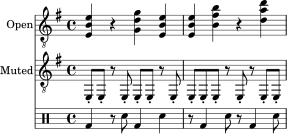
Open, muted, and displaced attacks
Isolate three articulation layers built from the same eighth-note grid. Playback begins only when you press Play.
Loading the optional player…
Static score: open and muted attacks
Source details follow the article.