
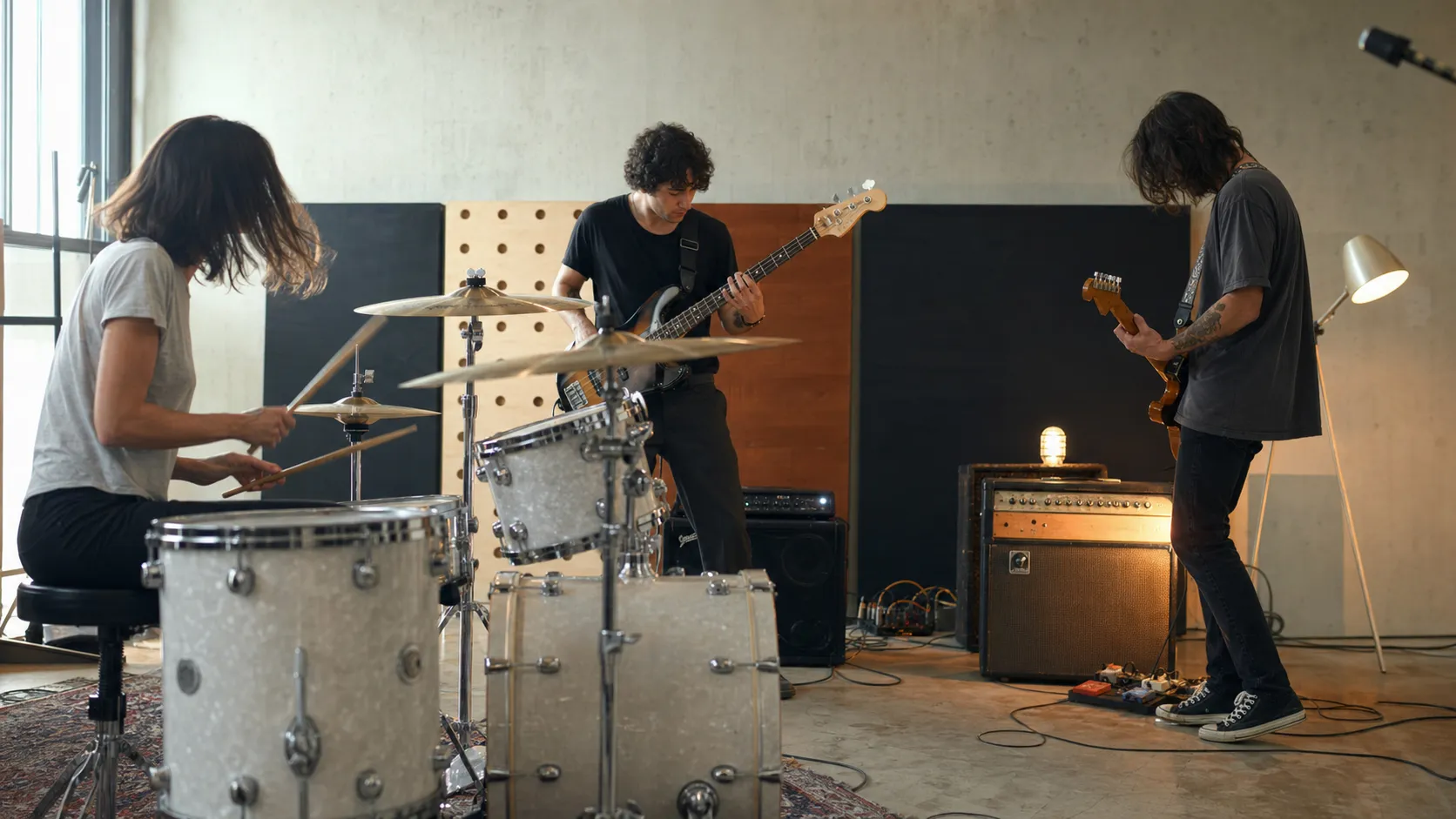
Begin below the guitar
Descriptions of rock often begin with electric guitar. That makes sense visually, but it can hide the mechanism that moves the song. Mute the guitar and follow the drum kit and bass. In many recordings, they establish the pulse, the length of the phrase, the points of tension, and the moment when one section gives way to another.
The Metropolitan Museum of Art describes accented backbeats, prominent electric guitars, repetitive chord structures, and a powerful straight-ahead rhythm among the traits of early rock and roll. It also stresses that the bass guitar and drum set supply much of the music’s intensity. 1 That history grew from several traditions, particularly Black rhythm and blues, blues, and gospel, alongside country and other forms. Rock is not the product of one instrument or one community. 2
Backbeat does not mean immobility
Count four even beats and listen to the snare. In a common rock pattern it emphasizes beats two and four. Those accents are the backbeat. The kick drum may reinforce beats one and three, but it can also place additional notes before or after them. Hi-hat or ride cymbal subdivisions reveal whether the bar is being divided into even eighth notes, shuffled pairs, sixteenth notes, or a less regular pattern.
A stable backbeat gives other parts something to push against. A bass note placed just before the kick can pull the phrase forward. A note held across the snare can make the bar feel broader. A short rest before beat one can make the next entrance seem heavier without changing tempo or volume.
The backbeat entered rock through Black American rhythm and blues, gospel, and blues rather than appearing with electric guitar. The Library of Congress describes postwar rhythm and blues as combining several of those traditions with a strong backbeat and connects it to early rock and roll. 4
Snare on two and four supplies reference points, not a complete groove. Kick placement, hi-hat subdivision, ghost notes, cymbal sustain, and bass duration determine what happens around them. A bass note held through beat two lets the snare cut across sustained pitch; a short simultaneous note makes the two instruments strike and stop together.
Locked does not mean identical
Musicians describe bass and drums as locked, but the phrase need not mean duplicated attacks. Berklee’s joint bass-and-drum lab combines connection, consistent time, and song form as separate professional skills. 5
Coinciding kick and bass create one kind of lock. Complementary patterns create another. A bassist may reinforce the first kick, answer later notes, and hold through a rest. The drummer may select only the bass line’s structural accents.
Write kick and bass on separate rows. Mark attacks, then draw duration. The diagram shows reinforcement, alternation, sustained support, and changes at phrase endings more clearly than counting simultaneous hits alone.
Tina Weymouth’s statement that drums lead reflects a specific partnership with Chris Frantz, not a universal hierarchy. 6 Other songs begin from a bass riff or guitar figure that the drummer frames. Leadership can also shift between sections.
Subdivision defines available motion
Quarter-note tempo describes the main beat. Subdivision describes what happens inside it. Even eighths divide each beat in two, sixteenths create four slots, and triplets create three. Shuffle lengthens the first part of a pair and shortens the second.
Berklee’s rock-and-funk lesson shows how a basic drum pattern changes character when bass emphasizes driving eighths or a lighter sixteenth-note feel. 7 Style belongs to the ensemble, not to drums alone.
Straight and swung are not always binary. Phil Gould points to productive tension between swung drums and straighter guitars in early rock and roll. 8 Listen to hi-hat, ride, shaker, or rhythm guitar first, then ask whether bass confirms that small pulse or leaves larger gaps around it.
Microscopic placement changes feel
Two performances can produce the same conventional score and feel different. Notation places an attack on a grid but rarely captures every millisecond of ensemble timing or the shape of a note after it begins.
Ahead and behind are relational terms. A snare can sit slightly later than a rigid reference while kick remains centered. Bass can begin after kick but stop early enough to keep the phrase urgent. The pocket comes from recurring relationships, not one globally shifted track.
Matthew Butterfield’s research on swing and participatory timing shows why small discrepancies must be read in musical context rather than labeled errors automatically. 9 Jazz findings do not explain every rock performance, but they provide a disciplined vocabulary for timing that notation omits.
Listen before measuring. Identify whether the backbeat seems relaxed or whether bass pulls into a chorus. Inspect waveforms only afterward if the session is available. Measurement should test an audible observation, not manufacture importance for a difference no listener notices.
Follow attacks, lengths, and gaps
Listeners often ask whether bass and kick are “locked.” The useful question is more specific: which attacks coincide, and which do not? Exact alignment can add weight. Separation can create dialogue. Neither approach is automatically tighter.
Note length matters as much as attack. A bass part made from clipped notes leaves room around the kick and guitars. Sustained notes connect beats and can make a sparse arrangement feel continuous. When a bassist changes from long notes to repeated eighths, the apparent energy can rise even if the drummer keeps the same pattern.
Duration shapes weight after the attack
An onset tells when a note begins. Duration determines how long its energy occupies the bar. A bass note that stops before the snare leaves an opening; one that rings through it binds the beats. Both can use the same pitch and attack point.
Drums also have duration. A damped kick ends quickly, while an open drum sustains low resonance. Closed hi-hat marks short subdivisions; ride cymbal creates a continuous wash. Technique, tuning, damping, room, microphones, and mixing all influence those envelopes.
Draw horizontal lines for bass sustain beneath marks for drum decay. The image reveals density after attacks. Compression can lengthen apparent sustain and a gate can shorten it, so check envelope before deciding that a timing edit is needed.
Bass can follow drums, guitar, voice, or harmony
Bass occupies a junction. Its attacks can reinforce kick, pitches can double guitar, movement can lead harmony, and rests can clear space for voice. No single partner governs every bar.
Exact guitar doubling adds low-frequency mass. Simplifying the riff lets guitar retain detail while bass marks structural accents. Independent movement can connect chords or create counterpoint beneath repetition. Follow how that choice changes when the vocal enters; form often matters more than maintaining equal busyness.
The riff can become percussion
A repeated guitar figure may carry pitch and harmony, but its picking also creates a sequence of attacks. Palm muting shortens those attacks; open chords extend them. When bass, kick, and guitar share selected accents, the riff feels physically unified. When they diverge, the groove gains counter-motion.
This is why “heavy” and “distorted” are not synonyms. A lightly overdriven part can feel heavy when its rests and attacks reinforce the rhythm section. A highly saturated guitar can feel less forceful when every gap is filled and each note loses definition.
Distortion adds harmonics and compresses peaks, allowing a guitar chord to occupy more of the bar. Palm muting shortens sustain and emphasizes attack. A muted riff can join the percussion grid, while an open riff behaves as sustained harmony.
Albin Zak treats the rock recording as a constructed musical object in which timbre and layering belong to the heard composition. 10 Rhythm-guitar sound therefore belongs inside rhythm-section analysis.
Fills change the map
Drum fills do more than decorate the end of a phrase. They can shorten the listener’s sense of the current section and announce a new one. Bass may follow the fill, hold a pedal note beneath it, or stop to clear space. Listen to the final bar before a chorus and identify which instrument changes first.
Dynamics operate on several scales. One snare accent shapes a beat. A busier final bar shapes a phrase. Removing cymbals can lower the apparent ceiling of a verse, allowing the chorus to expand when they return. None of these changes requires a faster tempo.
Fills can mark transitions, answer vocals, complete riffs, or cross an expected downbeat. A one-beat fill preserves most of the groove; a full-bar fill replaces it temporarily. Bass may hold, double the contour, stop, or lead independently. Each choice changes how securely the boundary is felt.
Dynamics organize sections
Players change velocity, density, register, cymbal choice, articulation, and sustain. A chorus can feel larger when the drummer moves from closed hi-hat to ride even if tempo and pattern remain stable. Bass can add attack or longer notes, or simplify beneath denser guitars to protect low-frequency clarity.
Michael Zager’s production text connects arrangement and production decisions. 11 Peak level alone cannot describe the change: sustained cymbals and guitars may raise average energy without producing the largest instantaneous peak.
Contrasting rock traditions distribute motion differently
Blues-based rock can retain shuffle and triplet inflection. Hard rock often emphasizes large drum envelopes and riff reinforcement, though many performances breathe around the grid. Punk may use direct eighth-note drive, while post-punk frequently promotes bass to melodic foreground and makes guitar sparse or percussive.
Funk-influenced rock distributes information across sixteenth-note layers and interlocking gaps. Anne Danielsen’s work on funk explains how repeated timing relationships create groove without reducing it to one beat. 12 Progressive rock may use changing meter or accents crossing the bar; alternative traditions can make restraint and unstable timbre central.
Deep Purple’s Ian Paice and Roger Glover describe their partnership through fluid drumming, listening, and parts that remain musical rather than merely metronomic. 13 Their example demonstrates why individual players matter more than a generic hard-rock template.
Production can strengthen or soften motion
Close microphones can make attacks immediate. Room microphones lengthen drums and place them in an audible environment. Compression can reduce level differences, but its timing can also preserve or soften the leading edge of a hit. Editing can align players tightly; excessive correction can remove the small disagreements that gave the performance its particular feel.
Double-tracked guitars add width because two performances contain small timing and pitch differences. Those differences also affect rhythm. Sound On Sound notes that repeated layering eventually blurs note onsets rather than making them stronger. 3 In the workbench, compare one guitar with both guitar takes. The wider version is not simply “more.” Listen for what happens to the pick attack.
Recording the section together preserves interaction
Tracking bass and drums together allows each player to respond to the other’s dynamics, fills, and phrase endings. The benefit is musical communication, not an automatic vintage sound. Separation, monitoring, room choice, and microphone spill determine how editable the result remains.
Recording separately can solve scheduling, isolation, or arrangement problems. A bassist can respond to a finished drum performance with detailed knowledge of every kick. The tradeoff is that the drummer could not react to that new bass interpretation. Neither workflow guarantees a better groove; they distribute decisions differently.
A usable cue mix is part of the performance. Too much click can make the players attack harder or stop listening across the kit. Too little bass can cause the drummer to rely on visual cues. Headphone latency can make performers compensate by playing early. Before editing timing, confirm that monitoring did not create the problem.
Microphones turn one performance into several time perspectives
A close kick microphone captures attack and body with relatively little room. Overheads receive the whole kit with later arrivals from different drums. Room microphones add more distance and reflections. These tracks describe the same performance from different positions, so their transients do not align automatically.
Moving every room transient onto the close-microphone grid removes the delay that conveys distance. Leaving all tracks untouched can produce cancellations when similar waveforms combine. Polarity inversion and small timing changes are diagnostic tools, not mandatory repairs.
Listen first to the overheads as a picture of the kit. Add close microphones one at a time, matching level carefully. If the snare becomes thinner, check polarity and timing. If it becomes closer but loses size, decide whether the room relationship or the close attack matters more for the song.
Bass can reach the recorder through a direct input, amplifier microphone, or both. The DI usually offers a defined electrical signal; the amplifier contributes speaker, cabinet, room, and microphone behavior. Combining them introduces another timing and polarity relationship. Align only after deciding which low-frequency body and attack the arrangement needs.
Albin Zak’s account of record-making emphasizes that these captured perspectives create the track heard by the audience rather than merely documenting a self-contained live event. 14
Quantization can repair or erase relationships
Quantization moves detected events toward a timing grid. Applied selectively, it can fix an entrance or stabilize a passage. Applied indiscriminately, it can alter the repeated placement that made the musicians sound connected.
The first decision is which events act as references. If kick is moved but bass remains, their relationship changes. If every drum microphone is edited independently, the kit’s internal phase relationships change. Multi-track drums should normally be grouped during timing edits so one physical hit remains one event.
Use the smallest correction that solves an audible problem. Compare the unedited and edited passages at matched loudness without watching the grid. If the edit improves one hit but makes the following phrase stiff, restore more of the original spacing or move a larger musical unit.
Percentage quantization or strength controls preserve part of the original deviation. They are useful only when event detection is correct. A detector that mistakes a cymbal spill for the main transient can move the wrong point. Inspect edits at quiet grace notes, flams, and fills before trusting a batch operation.
Editing note endings matters as much as starts
Comping and time correction often focus on onsets. Yet a bass note that overlaps the next chord can blur harmony even when it begins perfectly. A cymbal edit can cut off decay. Crossfades can create small level dips or duplicate low-frequency cycles.
Edit at musically quiet points when possible. For sustained bass, find a waveform region that allows a smooth crossfade without obvious phase cancellation. For cymbals and rooms, preserve continuous decay beneath the edit. Listen several bars before and after the join; a technically clean splice can still damage phrase shape.
Noise gates also edit endings dynamically. A gate on snare can reduce hi-hat spill but shorten ghost notes and room interaction. Set release while the whole kit plays. Solo reveals mechanics, but the ensemble determines whether the envelope feels natural.
Compression can change the apparent pocket
Compression reshapes attacks and sustain. A fast attack can soften the front of a kick or bass note, making it appear less immediate. A slower attack lets the transient pass before gain reduction acts. Release controls whether gain returns before the next subdivision.
If release follows the groove, compression can make repeated notes breathe. If it remains closed into the next attack, that note begins at a lower level and may feel weak or late. The meter shows gain reduction, but the ear must judge the phrase.
Parallel drum compression combines an aggressively controlled signal with the original. It can raise room tone, ghost notes, and decay while keeping dry transients. The additional density may create excitement or obscure the gaps that gave the beat motion.
Side-chain compression between kick and bass can separate low-frequency envelopes, but it also changes their performed relationship. If simultaneous attacks are meant to combine, heavy ducking removes the bass precisely when it should add weight. Use it to solve a specific masking problem rather than as a default rock technique.
Doubling changes rhythmic evidence
Two separately played guitars do not create width merely because they are panned apart. Their small differences in attack, duration, tuning, and tone make the stereo image active. Sound On Sound warns that stacked performances can blur attacks when timing is loose. 3
The rhythm section becomes the reference against which those differences are heard. If both guitars rush differently around a stable snare, the image can feel broad but restless. Tightening every pick attack to one sample removes the performance differences that made the double sound like two players.
Edit at the level of phrases and structural accents first. Let harmless internal differences remain. In mono, doubled guitars may become denser and narrower; check that their combined midrange does not conceal bass articulation or snare attack.
A practical listening sequence
First follow the snare through an entire verse. Next, track only the kick. On a third pass, notice where bass attacks match either drum. Then add the guitar and decide whether it reinforces the drum pattern, fills its gaps, or alternates between those roles.
This method works across early rock and roll, hard rock, indie rock, progressive rock, and many punk or metal recordings. The answers will differ. The point is to hear the rhythm section as an arrangement of choices rather than a background beneath the singer and guitar.
Interactive score
Build the rhythm section
Switch the drum, bass, and guitar parts on or off without changing the tempo. Playback begins only when you press Play.
Loading the optional player…
Exercise one: map the backbeat
Choose a recording with a clear drum kit. Count four and mark snare accents for eight bars. Add kick attacks on a second row. Do not add bass yet. Note whether the pattern changes at the fourth or eighth bar and whether a fill begins before the final beat.
Now add the bass. Mark attacks and duration separately. Circle coincident bass-and-kick events, then underline bass notes that continue across a snare. The result shows how the parts cooperate without forcing every note into the language of lock.
Exercise two: hear subdivision through different parts
Mute or ignore bass and kick. Follow hi-hat, ride, shaker, guitar, or keyboard. Vocalize the smallest steady subdivision. Decide whether pairs are even, swung, or inconsistent.
Restore bass and ask which slots it selects. A driving eighth-note part fills more of the grid than a line built from syncopated sixteenths and rests. Neither is intrinsically more energetic; articulation and tempo determine how the density feels.
Repeat the exercise in a contrasting rock tradition. Compare punk eighths with a funk-influenced post-punk line, or a blues-rock shuffle with a straight hard-rock riff. Use the comparison to describe difference, not to rank complexity.
Exercise three: separate timing from dynamics
Choose four repeated snare backbeats. First listen only to their loudness. Then listen to their placement against hi-hat or guitar. A louder hit may seem early because it attracts attention; a softer one may seem late because its attack is less defined.
If you have a session, copy the passage. On one copy normalize snare hits without moving them. On the other move them toward a grid without changing level. Compare blindly. The test reveals whether dynamics or timing caused the original sensation.
Exercise four: compare note endings
Loop a bass-and-drum phrase with permission. Shorten bass notes without moving their starts. Listen for kick definition and harmonic gaps. Then lengthen them until they cross snare accents or chord changes.
Return to the original. Its duration choices now have context. Describe them as short, connected, overlapping, or changing at phrase ends. Avoid calling short notes tight and long notes loose; either can be played with precise ensemble timing.
Exercise five: follow a fill through the whole band
Find a fill that leads into a chorus. Track what each instrument does from two beats before the fill to two beats after the arrival. Does bass hold, stop, climb, or double the drums? Does guitar keep subdivision? Does the vocal enter before or after the groove returns?
Repeat with a fill that crosses the downbeat. The contrast shows how a drummer can make form explicit or deliberately suspend it. Section boundaries are ensemble events even when the drum part supplies the most obvious signal.
Common analytical mistakes
The first is calling every stable performance metronomic. Consistency can include a repeated late snare, a swung hi-hat, and section-level tempo movement. Reserve metronomic for evidence tied to a fixed pulse, not for musicians who simply play together well.
The second is treating the bassist as a bridge between drums and guitar without examining the part. Bass may lead harmony, counter the guitar, or answer voice. The metaphor becomes useful only after the actual relationships are named.
The third is equating more notes with more motion. A rest before beat one can generate stronger forward pull than a fill across every subdivision. Sustained notes can create motion when harmony changes beneath them.
The fourth is confusing production precision with performance precision. Sample replacement, editing, and compression can make attacks consistent. That does not reveal how the original players interacted. Describe the record that is audible and distinguish documented session facts from inference.
The fifth is reducing rock history to white guitar bands. The backbeat and much of rock’s rhythmic language depend on Black rhythm and blues, blues, gospel, soul, and funk. Country, folk, Latin, Caribbean, and other practices also shaped local and individual approaches. Historical attribution belongs inside rhythmic analysis.
Form is the longest rhythmic cycle
A bar repeats beats; a riff repeats a pattern; a section repeats several bars; the song organizes sections into a larger cycle. The rhythm section operates at all of those scales. A bass turnaround can announce the end of eight bars before harmony changes. A drummer can withhold a crash so the second chorus feels less final than the last.
David Brackett argues for interpreting popular music through the relations among sound, genre, discourse, and listening rather than treating musical details as isolated facts. 15 A fill has meaning because of where it occurs and what a style teaches listeners to expect.
Make a section map before transcribing every hit. Label verse, chorus, bridge, solo, and transitions, then note which rhythmic element changes at each boundary. This prevents a detailed one-bar groove analysis from missing the motion created across the entire song.
Four contrasting ensemble strategies
A riff-led hard-rock section often asks bass and kick to reinforce selected guitar attacks. The power comes from agreement on structural accents, but continuous unison can make every event equally important. Short drum pickups, bass approaches, and changes in guitar sustain restore hierarchy inside the riff.
A punk section may use continuous guitar and bass eighths over a direct backbeat. Motion comes from endurance, downstroke articulation, chord-change timing, and short gaps before sections. Small accelerations can heighten urgency, but a controlled steady performance can sound equally forceful when accents remain clear.
A post-punk arrangement can reverse the usual register hierarchy. Bass carries the recognizable melodic ostinato while guitar supplies clipped chords, harmonics, noise, or space. Drums decide whether the bass feels dance-oriented, severe, or unstable through kick placement and cymbal subdivision.
A funk-rock crossover may distribute sixteenth-note information among hi-hat, ghost notes, bass, and guitar. No part needs to fill the grid alone. Anne Danielsen’s detailed approach to funk warns against hearing groove as a single synchronized block; layered placement and repetition produce the pocket.
These strategies can occur within one song. A verse may use melodic bass and sparse guitar, while a chorus shifts to riff unison. Describe the transition itself: which part surrenders independence, which subdivision becomes dominant, and what remains constant enough to connect the sections?
Rehearsal communication should name audible events
“Play tighter” can mean align attacks, shorten notes, reduce dynamic variation, simplify the pattern, or listen more closely. The instruction is too broad unless the band shares its meaning. Name the event: stop the bass before the snare, place the kick with the first guitar accent, keep hi-hat eighths through the fill, or delay the crash until the vocal enters.
Rehearse difficult relationships at reduced volume before reducing tempo. Lower volume can expose duration and listening without changing the subdivision. Slower tempo helps with physical coordination, but it may change note decay and the amount of space between events.
Record a complete take before correcting one bar repeatedly. The problem may be formal: a player does not hear the approaching section, or the arrangement gives no cue. A small pickup or shared breath can solve what isolated grid practice does not.
Use verbal count only long enough to establish the map. Once the pattern is secure, replace counting with listening to a designated cue. Ensemble time should not depend forever on every player running an internal narration of numbers.
Production should clarify the performed hierarchy
A close, bright kick and bass with strong upper harmonics can make the foundation readable on small playback systems. That translation is useful, but adding attack to every part creates competition. Decide whether kick click, bass pluck, guitar pick, or snare crack owns each important onset region.
Low-frequency separation can come from arrangement, pitch, duration, equalization, and dynamics. Assigning kick and bass rigidly to two frequency bands is only one technique. A pitched kick may overlap a bass note differently as harmony changes. Listen across the line rather than solving one isolated hit.
Room sound changes motion by extending drums beyond their attacks. A compressed room can make quiet strokes and decay surge between backbeats. A dry kit leaves more negative space. Blend room microphones while the bass and guitars play; soloed excitement may become rhythmic fog in the arrangement.
Michael Zager’s production framework and Zak’s study of constructed rock tracks both support treating these choices as musical organization rather than cosmetic finish. Production succeeds when it reveals the intended relationships and fails when every element is made equally large.
A final full-song pass
On the first listen, tap the beat and mark section boundaries. On the second, follow only snare and kick. On the third, sing the bass rhythm and note duration. On the fourth, identify the guitar or keyboard subdivision that fills the spaces.
On the fifth pass, stop tapping and listen for microscopic placement. Which backbeats feel late or urgent? Does bass consistently enter before or after kick? On the sixth, follow dynamics and cymbal changes across sections. On the seventh, compare the final chorus with the first and identify how the rhythm section creates escalation.
Write claims only after those passes. “The chorus moves forward” should be followed by evidence such as longer bass notes, ride cymbal eighths, an earlier kick pickup, denser guitar attacks, or a measured tempo rise. If no evidence appears, revise the description.
The method turns a vague impression of groove into testable relationships without pretending that every expressive detail can be reduced to a grid. Rock motion lives in attacks, sustain, silence, dynamics, timbre, form, and the decisions musicians make while listening to one another.
Motion does not require constant forward pressure
Rock can create motion by withholding it. A half-time chorus makes the backbeat arrive less often while guitars sustain across the larger spaces. A breakdown removes cymbals and harmonic density so the returning full beat feels faster without a tempo change. A held bass note can suspend the usual subdivision until the next riff restores it.
Restraint also protects contrast. If the drummer crashes through every section, cymbal change cannot announce the climax. If bass fills every gap, silence cannot pull toward a downbeat. If guitar doubles every kick, unison loses its ability to mark one decisive accent.
This does not make simplicity morally superior. Dense playing can be the point, especially when several layers interlock without masking one another. The useful question is whether each added event changes the groove or merely occupies an available subdivision.
Credit the rhythm section as creative work
Rock publicity and criticism have often centered singers and lead guitarists while session players, bassists, and drummers supplied defining hooks and feels. The Metropolitan Museum’s account of rock instrumentation notes both the central intensity of bass and drums and the frequent use of studio musicians whose contributions were not always credited prominently. 1
Attribution matters because rhythmic identity is compositional evidence. A bass line can define harmony and form; a drum entrance can make a chorus recognizable before voice or guitar arrives. Contractual songwriting credit and audible creative contribution are not always the same category, but analysis should name the player when reliable documentation allows it.
David Brackett’s interpretive approach keeps performance, recording, genre, and public meaning connected. 15 That wider frame prevents groove from becoming an anonymous mechanical property of “the song.” It was produced by people working within particular musical and industrial conditions.
What the rhythm section lets the listener know
At any moment, bass and drums can communicate pulse, subdivision, harmonic direction, section length, dynamic level, and an approaching transition. They need not communicate all of those functions continuously. Guitar, keyboard, voice, or production may carry some while the rhythm section emphasizes others.
Listen first for responsibility. Which part makes the beat unmistakable? Which part tells you that the phrase is ending? Which sound creates urgency, and which one keeps the band grounded? Then listen for transfer: a hi-hat may establish eighths until guitar takes over; bass may state the riff until the vocal entrance simplifies it.
Motion emerges from those transfers and relationships. It can be straight, swung, loose, rigid, heavy, restrained, or unstable. Those words become useful only when connected to attacks, lengths, gaps, dynamics, subdivision, form, and documented performance choices.
Form supplies the largest timing reference. Covach and Flory’s rock history demonstrates how recurring verses, choruses, bridges, solos, and contrasting sections organize what a listener expects next. 16 The rhythm section can confirm that map or work against it. A fill may announce a boundary, bass may cross it with a sustained note, or cymbals may delay the sense of arrival. Following those decisions across the whole recording keeps groove analysis from shrinking into one endlessly looped bar. It also reveals why a pattern that seems plain in isolation can carry substantial dramatic weight when it returns at the right moment. That function remains audible across repeated listens and performances.
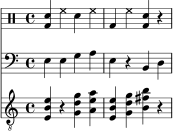
Static score: three related parts
This original example remains readable when the interactive player is unavailable.
Source details follow the article.