
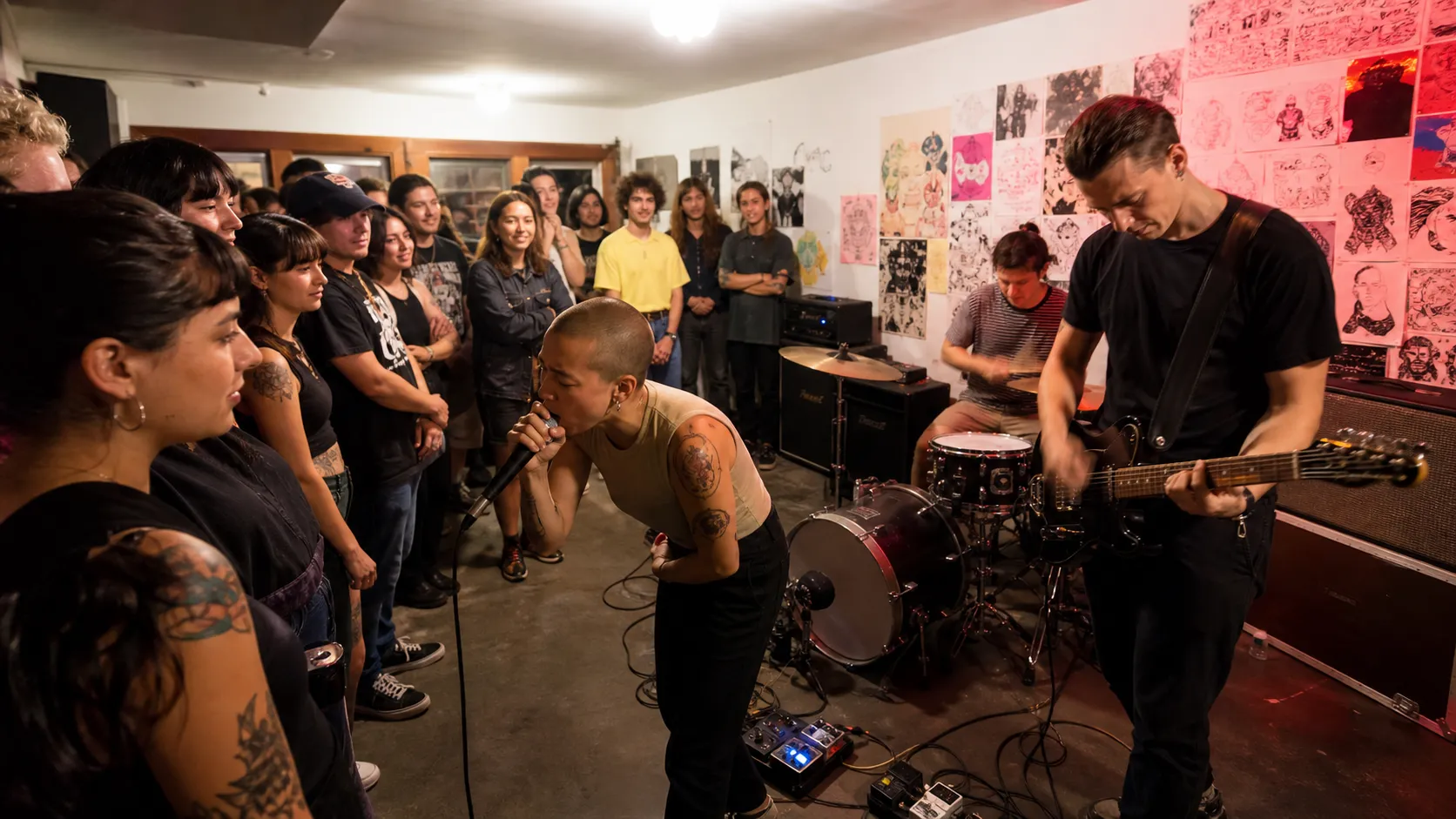
A scene before a settled label
Punk histories often compress several networks into one origin story. New York clubs, magazines, record shops, artists, and bands are central. London added its own venues, shops, managers, art-school connections, and political pressures. Earlier garage rock, glam, pub rock, experimental music, and confrontational performance supplied different precedents.
The British Library traces the musical use of “punk” to writing about 1960s garage rock, early flyers by Suicide, and the 1976 New York magazine Punk, before the term became attached widely to bands in New York and London. 1 This does not make the word more important than the music. It shows that scenes develop before their categories become stable.
What the first records changed
Many early punk recordings favored compact forms, strongly articulated guitars, prominent backbeats, direct vocals, and limited ornamental playing. These were choices, not proof that the musicians lacked technique. Economy could place more pressure on timing, tone, and phrasing because fewer layers concealed them.
Listen to chord attacks. Repeated downstrokes can make each subdivision feel equally deliberate. Open strings and amplifier noise may connect chords, while hard stops divide them. Bass might double guitar roots, move melodically beneath static chords, or provide the clearest pitched line in a thin mix.
Song length is another result rather than a rule. A short song can omit solos and repeated sections, but punk also produced extended repetition, dub-influenced space, noise, and art-rock structures. Post-punk did not simply become “more complex”; it pursued possibilities already present around punk’s edges.
New York and London were not interchangeable
The Met frames punk’s origin story through New York and London while emphasizing DIY materials, hardware, bricolage, graffiti, and agitprop in its fashion history. 2 Musically, the cities also differed internally. Treating either one as a single sound erases the variety of performers, venues, and audiences involved.
New York accounts often center CBGB, the magazine network, and bands whose approaches ranged from stripped rock and roll to poetry, art music, and minimal electronics. London punk developed amid different media conditions and class politics. Reggae and dub were audible neighbors, not remote influences; their bass, space, and sound-system practices entered parts of British punk and post-punk.
After the famous first wave
The year 1977 is useful because punk became highly visible, not because development stopped there. Bands split, changed sound, or moved toward post-punk. New participants built local networks with different tempos, politics, and resources.
American hardcore made songs faster, performances more physically compressed, and touring networks crucial. Yet hardcore was not uniform. Washington, Los Angeles, Boston, New York, and other scenes formed different relationships to rhythm, community rules, violence, politics, and production. A Library of Congress-hosted study describes touring and political organization as catalysts in American hardcore’s development. 3
Elsewhere, anarcho-punk, street punk, crust, melodic punk, pop-punk, and regional hybrids changed the balance between message, accessibility, noise, speed, and musicianship. Local language and conditions mattered. A map that runs only from New York to London misses much of the music’s later life.
DIY is a chain of decisions
DIY does not mean that every recording must be rough. It describes control over practical work: booking a room, recording with available equipment, duplicating a release, designing a sleeve, writing a fanzine, organizing a show, or distributing through independent networks.
These constraints can become audible. Few microphones may produce a narrow drum sound. Short studio time can favor live takes. A small room can put vocals, cymbals, and guitar spill into every microphone. Other punk records are carefully edited and layered. Neither production level authenticates the music on its own.
Participation changes performance
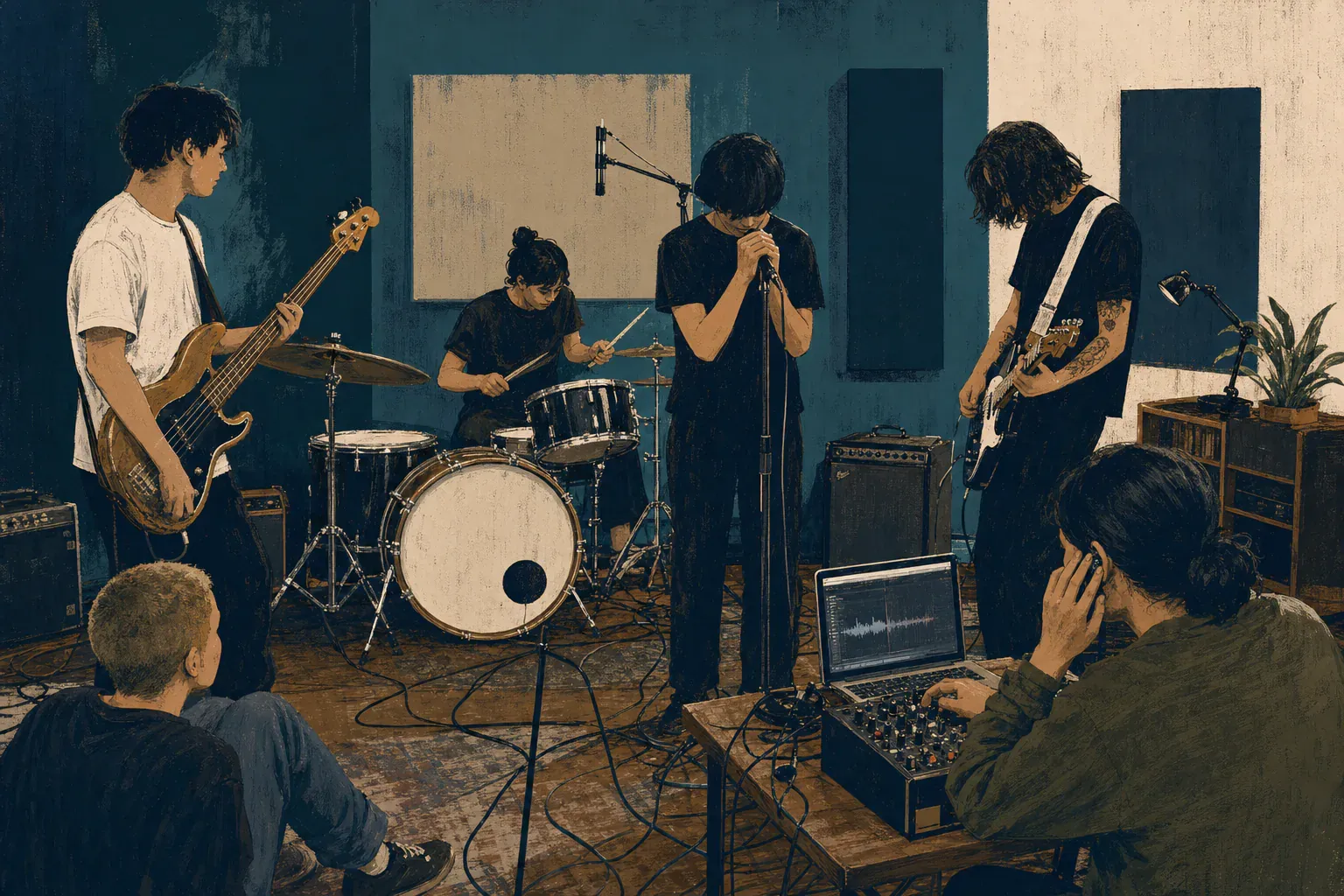
In a small venue, the distance between singer and audience can be a few centimeters. Group vocals turn a line into a collective event. A floor-level setup changes sightlines and movement. These are not captured fully by tempo or chord count, but they shape how the music is written and delivered.
The same applies to recorded address. A vocal can sound conversational, shouted, melodic, sarcastic, or controlled. “Raw” is too vague unless it identifies the mechanism: limited takes, audible room spill, clipping, narrow frequency range, unstable tempo, or a deliberately unpolished performance.
Listen without the costume
On the first pass, count sections and note their duration. On the second, follow only the guitar’s attack and silence. Then compare bass with kick drum. Finally, ask whether the vocal sits above the band or sounds embedded in the same room.
This sequence separates music from retrospective imagery. It also makes room for disagreement. Punk is a history of contested ownership and local reinvention. The most accurate guide does not force every record into 1977; it shows what later musicians kept, rejected, or rebuilt.
Records, print, venues, and the work of independence
A punk release begins before a listener drops a needle. Someone pays for a room or borrows one, chooses takes, sequences songs, prepares a master, orders or duplicates copies, makes sleeves, and tells people the object exists. DIY shifts some of those decisions toward musicians and their immediate network. It does not eliminate money, specialized skill, compromise, or outside help. O’Hara’s account treats punk as a field of political and practical commitments rather than a sound alone. [#ohara-philosophy] Laing’s study of early British punk likewise connects musical economy with the record industry, media, and audience. [#laing-chords]
Independent labels can widen participation while developing their own gatekeeping. A small label decides which band receives scarce pressing money and distribution attention. A shop or mail-order catalog determines what crosses regional boundaries. Hesmondhalgh’s study of Rough Trade examines both the democratic ambition and limits of post-punk’s attempt to organize production differently. [#hesmondhalgh-rough] Independence is therefore a relationship to resources, not a moral certificate printed on a sleeve.
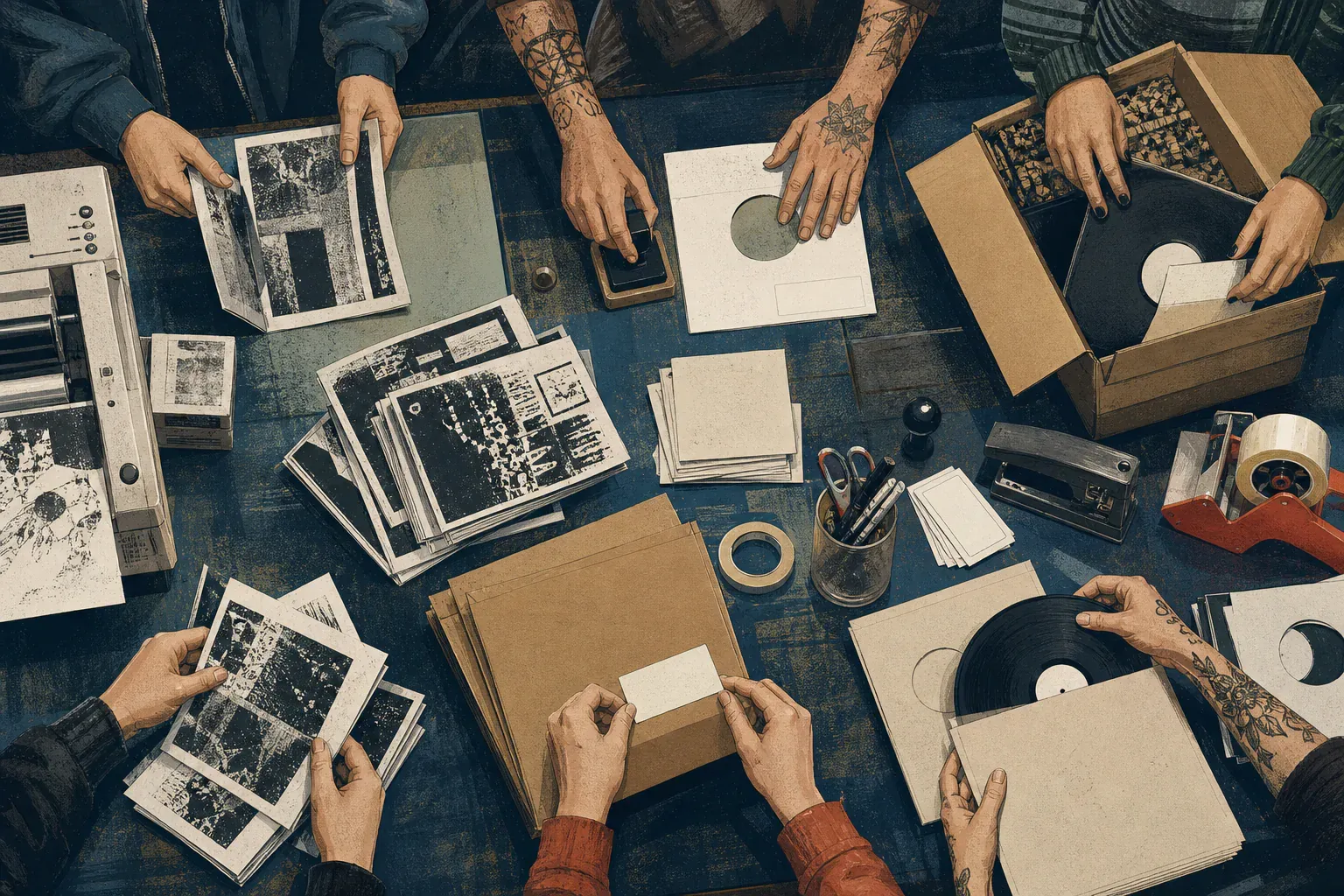
Fanzines turn listeners into editors, photographers, interviewers, reviewers, and distributors. Their inexpensive reproduction methods affect form: typed columns, handwritten captions, collage, correction fluid, staples, and uneven ink are consequences of tools as well as aesthetic choices. The Library of Congress describes zines as self-published, non-commercial publications, often with small circulation. [#loc-zines] That scale permits local argument and rapid response, but preservation can be fragile. Archives rarely capture every issue, insert, price list, or hand-to-hand exchange.
Venues complete the circuit. An all-ages community room supports a different audience from a licensed club. A floor show reduces separation between performer and crowd but creates practical questions about cables, exits, hearing protection, and harassment. A benefit concert redirects door money and attention toward another organization. A festival can connect distant scenes while making the music more legible to sponsors and media. These settings shape duration, equipment, address, and the likelihood that a new participant can organize the next event.
Touring converts a local network into a chain of trust. Promoters exchange contacts; bands share floors, amplifiers, fuel money, and warnings. Azerrad’s history of American underground bands documents how such circuits operated beyond major-label infrastructure. [#azerrad-band] The Library of Congress-hosted hardcore study adds political organization and repeated touring to the account. [#loc-hardcore] A breakdown in that chain can cancel a week of shows; a strong relationship can bring an unknown band into another city’s room before press coverage arrives.
What changed after visibility arrived
The familiar 1977 story is partly a story of media concentration. A small number of London bands, photographs, shops, and controversies became international shorthand for a larger field. Savage reconstructs British punk through that dense meeting of music, fashion, management, press, and politics. [#savage-england] Sabin’s edited collection questions simple myths and asks how punk’s meanings were produced and contested. [#sabin-punk] The Cambridge review of punk historiography warns that claims about punk’s meaning need evidence from what participants said and did in changing contexts. [#cambridge-punk-history]
New York’s chronology remains different. Oral history collected by McNeil and McCain places musicians, writers, artists, venues, and personal conflict inside a pre-1977 network. [#mcneil-kill] A single line from garage rock to CBGB cannot contain minimalist poetry, glam theatricality, art-school experimentation, hard rock, and electronic noise. The magazine Punk helped stabilize a word that already had older uses, as the British Library account shows. [#bl-punk-word] The category grew by selecting from a scene rather than by naming one agreed musical blueprint.
British punk’s visibility also opened routes away from its first compressed format. Reggae and dub offered models of bass weight, versions, studio transformation, and sound system address. Art schools supplied access to performance ideas, visual production, and critical theory, though their role differed by city and class. Butt’s study of Leeds traces how an art-school environment fed a post-punk scene whose musicians questioned rock convention rather than merely adding polish. [#butt-leeds]
Hardcore later intensified speed, brevity, and bodily pressure in many American scenes, but it created no single national norm. A straight, fast eighth-note drive can sit above a half-time snare; another band may use abrupt meter changes, funk-derived bass, or long noise sections. Recording may be dry and narrow, or carefully layered. Political language ranges from personal discipline to collective action and reactionary violence. Scene names should identify a local and historical relationship before they are used as audio presets.
Anarcho-punk made production and distribution part of explicit political practice. Benefit records, shared addresses, dense sleeve writing, and cheap admission linked message to infrastructure. Other punk networks focused on melody, skateboarding, queer community, feminism, anti-racist work, regional language, or simply the pleasure of a small loud band. Hebdige’s account of subcultural style remains influential, but later work complicates any clean story of symbolic resistance and commercial incorporation. [#hebdige-subculture] Worley’s history of British punk from 1976 to 1984 emphasizes the plural political concerns, fanzines, independent labels, and provincial scenes that continued beyond the first headlines. [#worley-no-future]
Practice: hear, record, and circulate a compact song
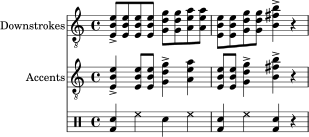
Write sixteen bars using two power chords and one single-note bass movement. Use eight bars for a verse, four for a refrain, and four for an ending. The limitation is a way to expose decisions, not to imitate incompetence. Play the verse with continuous downstrokes, then move one accent from the beat to the following eighth note in the refrain. End with a full-band stop. If the stop is unclear, shorten notes before adding more distortion.
Ask bass to try three roles. First double guitar roots. Then hold longer notes across guitar changes. Finally use a short connecting figure before the refrain. Record each without changing guitar. The experiment demonstrates why punk cannot be reduced to three-chord guitar: bass duration can make the same chords feel driving, suspended, or melodic. Add kick only after deciding which bass attacks need reinforcement.
Interactive score
Downstrokes, accents, and the stop
Hear continuous motion, a changed accent pattern, and the silence that closes the phrase. Playback begins only when you press Play.
Loading the optional player…
Record the band together with a practical setup: a stable pair or small set of drum microphones, one guitar microphone, bass DI or amplifier microphone, and a vocal guide. Check that cymbals do not dominate every channel. Move amplifiers or players before buying a solution. Capture a complete take, including count-in and decay. Then make one repair pass for events that hide the song’s structure. Leave small timing motion intact when it supports the performance.
Prepare a release sheet with credits, recording date, contact route, lyric permissions, and image rights. Decide what can be made locally and what requires a specialist. Price postage and packaging before announcing a physical edition. For a digital release, retain lossless masters and plain metadata. For a zine, print a small proof and fold it before duplicating the full run; page order errors are easier to prevent than to explain.
Finally organize a listening event or small show around safe capacity, access, clear payment, hearing protection, and an explicit contact for problems. Participation is not created by claiming there is no barrier between band and audience. It is created by doing the work that lets more people enter, leave, contribute, and organize again. The Met exhibition’s attention to bricolage and material practice is useful evidence, but the music’s history exceeds museum objects. [#met-punk] Compare the finished song with the process that carried it outward. Both belong to punk’s history.
Lab one: attack, accent, and stop
Play straight eighth-note downstrokes on one power chord at a tempo where the picking arm stays relaxed. Accent the first attack of each bar without changing the other seven. Then accent the offbeat after beat two. The chord and tempo remain fixed while the phrase leans differently. Record both with a clean enough tone to hear the pick, then add gain and check whether the accent survives.
Move between two chords while keeping the hand continuous. Listen for the tiny gap caused by the fretting-hand change. Decide whether to preserve that breath or bridge it with an open string. Both occur in punk guitar; one gives a hard joint, the other a smear of motion. Write the choice into rehearsal notes instead of letting each take solve it by accident.
End after beat three and mute guitar, bass, and cymbals together. A convincing stop needs release coordination. Ask each player to exaggerate the silence for one pass. Add vocal breath or room noise only after the instrumental boundary is clear. The rest is part of the riff, not empty time awaiting another layer.
Raise tempo in small steps and note where downstrokes become uneven. Do not conceal the threshold with compression. Practice short groups with a loose shoulder and consistent pick depth. Speed is useful only while attacks and the intended stop remain audible.
Lab two: three bass approaches
Under the same guitar part, play roots as matching eighth notes. This merges bass with the guitar’s surface and leaves kick to strengthen selected attacks. Next hold roots for a full bar. The guitar still drives, but the low end becomes a stable floor. Finally write a line that connects chord roots with two passing notes and enters during the guitar’s hard stop.
Compare on a small speaker. The moving line may retain pitch identity when distorted guitar loses fundamentals; the held roots may give vocals more room; the exact doubling may produce the most unified impact. None establishes authenticity. Each answers a different arrangement problem.
Have drums keep the same backbeat across all versions. Then adapt kick to bass: first duplicate every root attack, then only phrase beginnings, then maintain an independent four-on-the-floor pattern. Write which relationship makes the chorus arrive. This connects punk to the wider history of rock rhythm sections without treating it as a reduced version of rock.
Lab three: a room with limited microphones
Place the band in the room before placing microphones. Keep loud guitar cabinets away from the drummer’s quietest side of the kit and aim them so direct sound does not fire into every drum microphone. Use doors, blankets, or screens only when they improve a specific spill problem; a dead improvised booth can remove the shared sound that makes a live take cohere.
Start with a simple drum capture and listen from verse through ending. Add a microphone only when it solves an inaudible element. Check cymbal balance at the player’s position, because no microphone choice repairs a crash struck far louder than snare. Capture bass by DI if the amplifier cannot be separated, and monitor whether latency changes the player’s feel.
Record one complete guide vocal in the room, accepting spill. Replace it later if the song needs clearer words, but keep the guide for energy and edit reference. Print a mix after the session before changing every noise. A technically limited capture can be musically complete; a crowded session can be technically elaborate and still hide the band.
Lab four: make the physical edition accountable
Request quotes for a short-run duplicated format and for pressed records. Include mastering, test copies, sleeves, freight, taxes, damaged units, and the time needed for assembly. Divide by a realistic number of sellable copies. A low advertised unit price can conceal setup costs or labor shifted onto unpaid friends.
Prepare masters in the format requested by the manufacturer and keep lossless archival files. Order a proof or test when the process allows it. Listen for channel order, truncated starts, added gaps, and distortion on the loudest passage. Do not approve by photograph. The object carries audio decisions as well as visual ones.
Credit recording, artwork, photography, layout, manufacturing, and contributors. Obtain permission for every image and text excerpt. A DIY ethic does not make other people’s work free. Set aside contributor copies before announcing stock and write a simple record of costs and income for benefit releases.
Pack one copy and weigh it. Test the mailer by dropping it and exposing it briefly to light moisture. State shipping terms plainly. These tasks sound distant from chord attacks, yet they determine whether the recording arrives usable and whether a small network can afford to continue.
Lab five: organize a bill rather than a brand
Choose a room by safe capacity, access, transport, sound limits, toilets, exits, and the people who operate it. Confirm load-in, curfew, backline, payment, and age restrictions in writing. A striking poster cannot solve an inaccessible entrance or a payment agreement that disappears at the door.
Build a bill whose running order and changeovers are practical. Share amplifiers only after bands agree on impedance, volume, and responsibility. Leave time for a sound check that establishes vocal intelligibility and safe monitor levels. Provide earplugs without making protection a test of commitment.
Name a contact for harassment and emergencies. Decide how the team will pause music, clear an exit, or remove someone. Tell performers how door income is counted and when it is paid. If the event benefits another group, publish the calculation after costs. Trust grows through visible procedure, not a slogan about community.
Afterward, note attendance, access problems, sound complaints, injuries, costs, and what new participants want to organize. Archive the poster, running order, and a short account with consent. Scene history is built from these ordinary records as much as from famous photographs. The next event should inherit concrete lessons rather than only the visual memory of a crowded room.
Lab six: compare New York and London without a race
Select four recordings made in or connected to each city before the end of 1978. Include different approaches rather than four examples that already prove one thesis. For every track, note form, guitar attack, bass independence, vocal address, studio space, and any obvious relationship to earlier rock, glam, reggae, poetry, or experimental music.
Build two timelines with venues, publications, shops, releases, and participant movement. Do not join them at an invented moment of transmission. Records and people traveled, but each city also had local histories and internal disagreements. McNeil and McCain’s oral history can supply participant voices for New York; Savage supplies a densely documented British account. [#mcneil-kill] [#savage-england] Treat memory as testimony with a viewpoint, not a perfect transcript.
Write one paragraph about overlap and one about difference. Ban the words invented, authentic, and copied unless a source directly supports the specific claim. The exercise should explain how a name linked scenes without turning punk into a trophy one city must win.
Lab seven: trace one local network
Choose a city outside the usual origin pair. Find a venue, rehearsal place, shop or distributor, fanzine, radio program, label, and at least three bands. Record dates and addresses only when publication is ethical and safe. Note which nodes existed together and which appeared later; a retrospective scene map can accidentally connect people who never shared a room.
Follow one release outward. Who recorded it, manufactured it, reviewed it, stocked it, played it on air, exchanged it by mail, and booked the band? If evidence ends, mark the gap. A small circulation number does not make the record unimportant, and a later collector price does not describe its original reach.
Compare the network with Azerrad’s touring accounts and the Library of Congress-hosted hardcore study. [#azerrad-band] [#loc-hardcore] Identify which practices transfer and which depend on local geography, law, transport, language, or available rooms. Publish a short source note so another researcher can correct the map.
Lab eight: read a fanzine as production
Choose one issue available through a library or consent-based archive. Record page size, reproduction method, binding, price, contributor credits, advertisements, distribution notes, and reader correspondence. These details show how the publication moved, not only what its articles claimed.
Compare an interview, review, scene report, and editorial. Note who speaks and how much context the editor provides. A hostile review may reveal local boundary work; an advertisement may document a release date more reliably than later memory. Do not treat provocation as neutral fact.
Make a four-page zine about the practice song. Use only images and writing you have rights to reproduce. Print, fold, and read the proof in ordinary light. Revise type size, contrast, margins, page order, and credits. The Library of Congress zine guide helps locate collections and practical resources. [#loc-zines] The result should be readable, portable, and attributable before it looks historically punk.
Lab nine: distinguish roughness from damage
Take the live-room recording and identify every feature described casually as raw. Mark room spill, clipping, background noise, narrow bandwidth, unstable tempo, vocal overload, pick scrape, and cymbal imbalance separately. Some may support immediacy; others may hide words, cause fatigue, or make later manufacture fail.
Create two revisions. In the first, solve only technical damage: dangerous peaks, DC offset, accidental dropout, or an edit click. In the second, also reduce spill and timing motion. Match loudness and compare. Ask which revision retains the band’s relationship and which simply sounds more processed.
Do not preserve a painful or inaccessible playback condition in the name of authenticity. Control harshness, provide lyric text, and protect hearing at shows. Punk’s economy can be direct without using listeners’ discomfort as proof of seriousness.
Lab ten: follow a song after 1977
Choose one musical device from an early recording: continuous downstrokes, a melodic bassline, a group vocal, a hard stop, or a dub-like drop in texture. Find later uses in hardcore, anarcho-punk, post-punk, pop-punk, or a local hybrid. Keep the device constant enough to compare while allowing tempo, politics, production, and language to change.
For each later example, name what was retained and rebuilt. A faster tempo may compress the downstroke; a cleaner chorus may turn group address into a hook; a benefit release may connect the song to a different infrastructure. Worley’s history documents how British punk expanded through political and provincial activity after its first visible moment. [#worley-no-future]
End the chain when evidence becomes resemblance alone. Influence requires more than two similar chords. Interviews, shared bills, acknowledged records, labels, and touring links can support a relationship. The point is not to prove that every later guitar song is punk. It is to hear how practices move through people and institutions while acquiring new local meaning.
Lab eleven: compare vocal address
Choose a conversational vocal, a shout, a melodic chorus, and a group response. Transcribe rhythm and entrances without judging technique. Note whether the singer anticipates the beat, sits with snare, or stretches over a hard stop. Then mark room spill, distortion, and distance from the microphone. Delivery and recording are separate variables.
Perform one lyric in all four approaches over the same band take. Keep words and level stable. The experiment shows how address changes participation: a close conversation asks for attention differently from a group line built for a room to answer. Preserve intelligibility; urgency does not require every syllable to clip.
Lab twelve: map politics to practice
Select a record with an explicit political claim. Read lyrics, sleeve notes, interviews, benefit information, label practice, and distribution history. Do not assume agreement between message and working conditions. Record what is documented, what participants disputed, and what cannot be known.
Ask how form supports the claim. Repetition may make a line collective; a brief song may compress an argument; an extended collage may place voices and evidence beside music. Avoid praising politics only because the guitar is fast. The relationship must be shown in words, performance, circulation, or action.
Lab thirteen: preserve an event without inventing it
Collect a poster, set times, final accounts, and a short organizer note. Request consent before archiving photographs or personal messages. Caption images with date, place, creator, and whether the scene was staged. Do not reconstruct missing moments with generated documentary pictures.
Store audio in a lossless format and create an access copy. Add performer and engineer credits, but respect requests for anonymity. A useful archive can admit gaps. Its job is to retain evidence, not make an ordinary event look legendary.
Lab fourteen: compare formats
Sequence the same four songs for a short digital release, cassette side, and seven-inch record plan. Account for side length, level, pauses, and manufacturing constraints. The order that works as a playlist may create a weak physical side or place the hardest cut at an unsuitable point.
Prepare one-page notes explaining compromises without romanticizing them. Format limits can encourage a compact sequence, but missed deadlines and poor masters are not creative virtues. Listen to tests on modest equipment and correct faults before producing copies.
Lab fifteen: invite a new organizer in
Give one concrete task to someone who has not organized before: door accounting, access notes, running order, zine proofing, or mail packing. Explain the decision boundary, budget, contact, and how to ask for help. Do not call unpaid confusion empowerment.
Afterward, review what information was missing and update the checklist. Shared knowledge makes a scene less dependent on one exhausted person. The durable achievement is not a perfectly branded event; it is a process another group can understand, question, and use.
Lab sixteen: edit a compilation without flattening scenes
Choose eight tracks from different places and years. Request masters, credits, dates, permissions, and short participant notes. Do not normalize every track into the same loudness and tone before comparing its role. A narrow rehearsal recording and a detailed studio production can coexist if sequencing and mastering preserve intelligibility.
Write notes that identify location, practice, and connection without declaring each track a representative specimen. One band cannot stand for a city, gender, political position, or decade. Invite contributors to correct factual errors and state the editorial method.
Sequence by musical conversation rather than a false evolution from primitive to advanced. A 1976 track can follow a 1990s recording when their basslines or vocal address illuminate one another. Explain the choice without implying direct influence unless evidence exists.
Lab seventeen: compare rehearsal and release
Record one rehearsal from a stable room position, then compare it with the finished release. Mark changes in tempo, arrangement, guitar layering, vocal phrasing, and song length. Decide which changes clarify the idea and which simply conform to production habit.
Ask performers what they were trying to preserve. A release may tighten stops while retaining push in the verse, or replace room spill while keeping a group vocal. Document the decision instead of calling one version real and the other artificial.
Use the rehearsal as historical evidence with consent and context. It records work in progress, not a secret authentic essence. Date it, credit the recorder, and avoid sharing private discussion captured between songs.
Lab eighteen: test access in the finished package
Check lyric contrast, type size, link labels, image descriptions, captions, and reading order. Provide a plain digital text version when visual collage makes words difficult. Caption audio or video speech and identify music without pretending captions replace the sound.
Ask someone using keyboard navigation or screen magnification to test the release page. Fix focus order, unlabeled controls, and horizontal overflow. Accessibility is part of distribution: a record that claims participation while its information cannot be read is leaving practical work unfinished.
Print a sleeve proof at final size. Small type that works on a monitor may fail on paper. Keep essential credits and contact clear. Dense writing can remain dense in thought without becoming physically illegible.
Lab nineteen: close the accounts
After a release or event, list every expense, payment, donated resource, damaged copy, and remaining unit. Pay agreed shares before treating the balance as future project money. For benefits, publish the amount transferred and retain a receipt when appropriate.
Record unpaid labor without converting friendship into an imaginary market invoice. Knowing who carried design, transport, cooking, door work, or cleanup helps distribute the next project more fairly. Thanking people publicly does not replace rest or payment.
Archive the final budget with private information removed. Later organizers can price a room or pressing realistically instead of repeating avoidable loss. DIY becomes durable when knowledge travels with enthusiasm.
Lab twenty: write the concise historical note
Summarize one local release in 250 words. Include date, place, participants, recording conditions, distribution, and two audible traits. Use a contemporary source and a later source, and distinguish their viewpoints. Do not claim the record changed music unless the evidence shows a traceable consequence.
Remove stock phrases about raw energy, rebellion, and a generation’s voice. Replace them with the size of the room, the rhythm of the guitar, the role of bass, the route copies took, or the problem organizers tried to solve. A reader should learn something that could not be written from cover art alone.
Ask a participant to check names and chronology without giving them control over critical interpretation. Correct facts, preserve documented disagreement, and state unresolved points. Publish image rights and captions. The note should make the release easier to understand without turning limited evidence into legend.
Place that note beside the listening exercise and physical-process record. Punk history then appears as music, labor, argument, and circulation. None of those dimensions is a decorative extra, and none can stand for the others by itself.
Return to the note after hearing the full release at ordinary volume. Add one observation about silence, duration, or interaction that the first draft missed. Remove one claim that depends on reputation rather than the recording or source record. Check that every person is named as they request, every quotation is licensed or brief, and every image is identified accurately. A compact history earns trust through bounded detail. It should leave enough evidence for another writer to extend or correct it without first undoing a myth.
That restraint leaves the local record open for future participants too.
Static score: continuous downstrokes and a hard stop
Source details follow the article.