
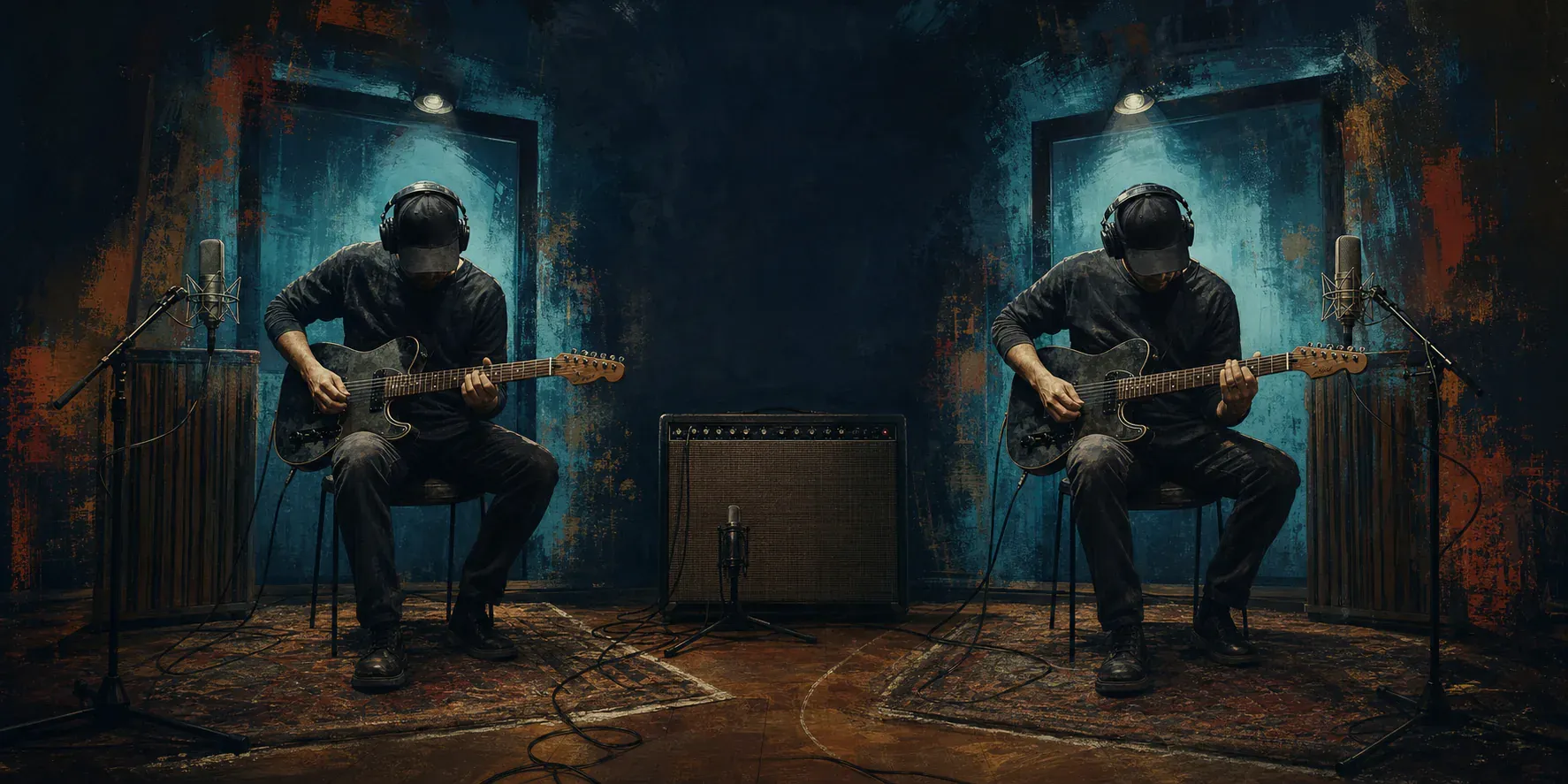
Perform it again
Copying one recording creates another identical file. Double tracking requires another performance. Even a precise player introduces small differences in attack time, tuning, pick angle, muting, and note length. Played together, those differences prevent the tracks from behaving like one perfectly centered source.
Engineers often pan the takes apart. Sound On Sound describes two separate performances as double tracking and four as quad tracking. 2 The method is common for guitars and vocals, but it can be used wherever controlled variation is useful.
What to listen for
In the guitar workbench, begin with guitar left. Add guitar right and listen at the edges rather than the center. The riff grows wider, while individual attacks become slightly less singular. Add drums to judge whether the combined guitar still supports the groove.
More layers can eventually weaken definition. Sound On Sound notes that stacking performances can blur note onsets. 1 Distorted parts accumulate high-frequency texture quickly, so each take may need less gain than a convincing solo tone. Check the result in mono as well: panning can impress in stereo while timing or phase relationships make the combined sound less stable elsewhere.
The differences that create width
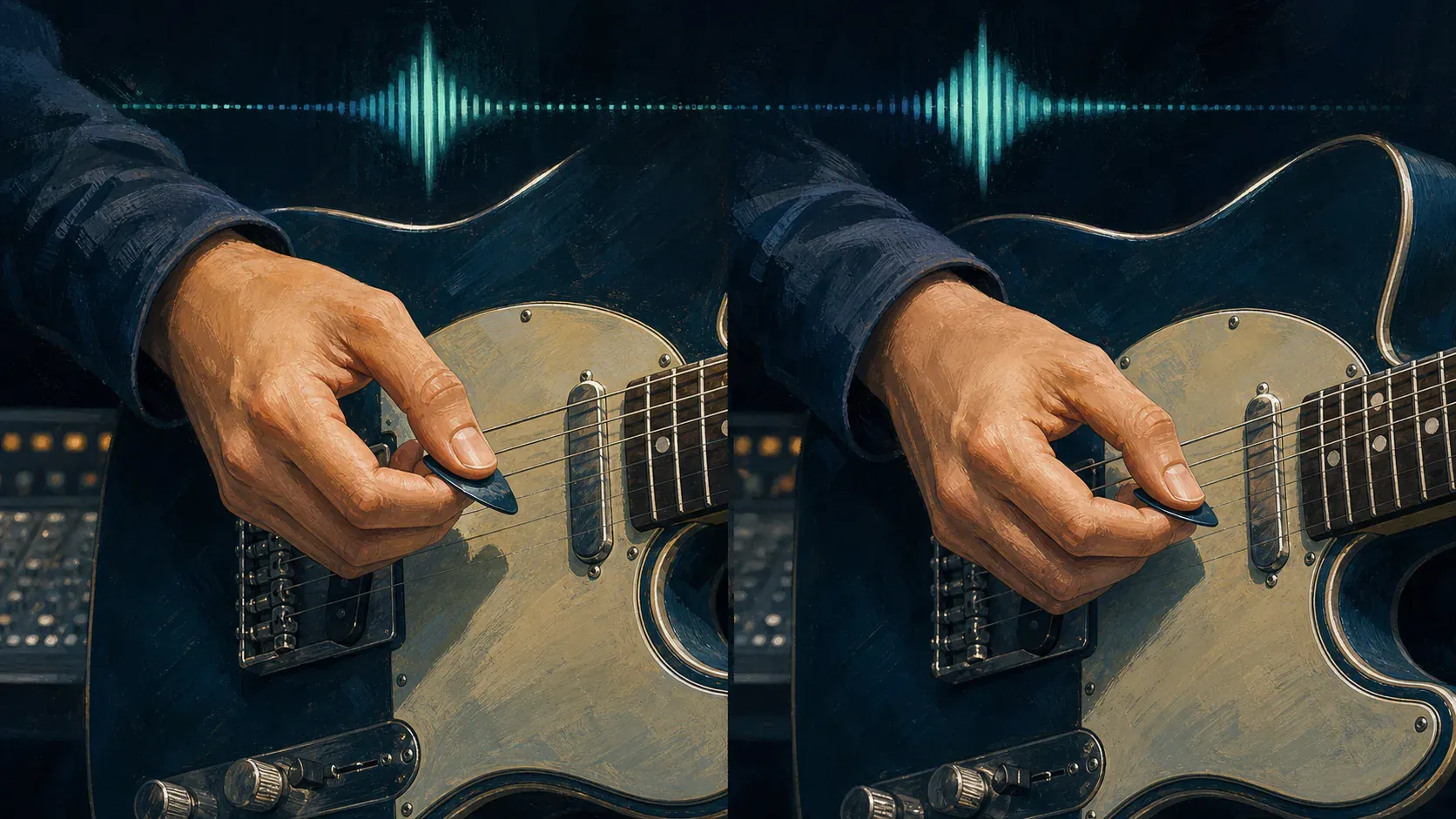
Two takes differ on several time scales. The largest difference is usually the start and end of a note. One pick arrives a few milliseconds earlier, one mute lasts longer, or one chord change contains a trace of the previous string. Inside each sustained note, pitch and spectrum keep moving. Finger pressure, vibrato, pick angle, string excursion, and amplifier response never follow exactly the same path twice. Those changes give each side evidence of a separate event.
The goal is not maximum disagreement. If one take regularly enters a sixteenth note late, listeners hear an error or a second rhythm. If every onset is edited to the same sample, the pair can lose the motion that made it worth recording. The useful region lies between those extremes and changes with tempo, articulation, and arrangement. A slow sustained part can tolerate more onset spread than a fast stop-start riff. Sound On Sound’s doubling guide describes both the thickening and the risk that too many layers smear definition. [#sos-doubling]
Pitch difference works in the same bounded way. Two well-tuned guitars still produce small beating because fretted pitch responds to touch and strings do not oscillate as perfectly fixed sources. If one instrument is poorly intonated, beating speeds up and specific chords pull to one side. Tune before each complete take, check the fretted region used by the part, and avoid treating a tuner display as proof that performance pitch is settled.
Tone difference can be created or simply allowed. Using the same guitar, pickup, amp, microphone, and player makes performance variation the main source of width. Changing pickup or microphone position adds spectral contrast, which may separate sides but can also make the stereo balance feel unequal. Begin with matched conditions. Change one element only when the song needs a brighter and a darker edge.
Double tracking is not a copied delay
Duplicating a file and panning the copies apart does not create width because the two channels remain identical. Equal signals at equal levels form a phantom center. Move one copy later and the channels become different, but the relationship is fixed: every note has the same offset, pitch path, and envelope. That can produce localization and comb filtering rather than the changing edges of two performances.
Short delays interact with the precedence effect. The AES reference traces the effect to research on how listeners localize closely spaced arrivals and reproduces the classic work in its journal archive. [#aes-precedence] In a stereo guitar treatment, the earlier side may pull attention toward itself even when both speakers carry related material. The result can sound wide from one seat and lopsided from another. It is a useful effect, but it should not be mislabeled as performance double tracking.
Artificial double tracking has its own history. Abbey Road describes how Ken Townsend used separate tape-machine paths and varispeed control to create a movable delay for the Beatles, commonly around eight to twelve milliseconds in the original system. [#abbey-adt] The modulation supplied changing delay and pitch behavior that a static copy lacks. ADT was devised to avoid another vocal performance; its name records that difference. It can sound excellent on guitar while remaining technically distinct from two played takes.
Chorus, flanging, and micro-pitch shift occupy related territory. Chorus uses modulated delay to suggest changing performers. Flanging brings delay close enough for a moving comb-filter pattern. Micro-pitch treatments shift sides by small amounts and often add delay. Each can widen one performance without the labor of replaying it. Choose among them by listening for motion, center stability, and mono behavior, not by assuming one is a cheaper version of the others.
Two microphones on one amplifier are another separate case. Both channels capture the same performance from different positions. Their time difference is tied to acoustic path length, so summing them can create stable comb filtering. Sound On Sound’s two-mic guide recommends checking polarity, waveform timing, and mono while treating the mic blend as one guitar sound. [#sos-two-mic] Pan that pair apart and the timbre may change dramatically in mono. Two performances recorded with one microphone each do not have one fixed phase relationship to align.
Tracking: prepare the performance before refining the tone
Choose a reference take that communicates the part from beginning to end. A composite is acceptable if edits preserve breath, pick noise, and transitions, but a complete take often gives the second performance a more coherent model. Print or note chord voicings, string choices, muting points, and intentional noises. “Play it the same” is too vague when the first take uses different inversions or lets open strings ring only in one section.
Monitoring affects precision. Give the player enough drum transient and reference guitar to locate attacks without turning headphones painfully loud. Too much first take can make the second player imitate tiny hesitations; too little can lose stops. Some players track better to drums and bass alone after learning the part. Record a short comparison before committing to the whole song.
Keep the instrument physically stable. Fresh strings may be helpful, but two takes made on opposite sides of rapid string stretch can sound less matched. Check tuning, bridge, pickup selection, pedal state, and noise between passes. Huber and Runstein place such source and signal-path decisions within the broader discipline of modern recording. [#huber-recording] A clean DI can preserve a reamping option and reveal whether a fuzzy attack comes from performance or amplifier.
Gain should be chosen for the pair. Distortion compresses the envelope and adds upper harmonics; stacking it raises continuous high-frequency density. Sound On Sound’s modern metal article recommends separate performances and warns that excessive gain can obscure definition. [#sos-modern-metal] Reduce gain until each take still speaks beside drums and bass. The soloed side may seem smaller, while the pair becomes clearer and larger.
Record the second take as a full performance before repairing bars. The player needs to learn where the first take breathes and where it pushes. A series of isolated punches can make every local event accurate while producing inconsistent energy across the song. Capture at least two complete alternatives. Choose for groove first, small noises second. Zak’s study of record-making is useful here because a rock recording is constructed through performances and studio decisions rather than serving as a neutral container. [#zak-rock]
Editing timing without erasing the pair
Listen before looking at waveforms. Mark places where the riff’s identity becomes unclear, where a stop fills in, or where one side attracts attention for the wrong reason. Then inspect the marked regions. Visual alignment without audible diagnosis encourages edits that solve no problem.
Classify each issue as attack, duration, pitch, articulation, or noise. Move an attack only when it changes the groove. Trim an ending when it covers an intentional rest. Use another take for a bent chord rather than trying to tune complex distorted audio. Preserve pick direction and palm-mute character across an edit. A technically seamless splice can still sound wrong if it replaces a downstroke with a lighter upstroke.
Choose an anchor. In a metal riff the kick or stronger guitar take may define unisons. In a loose strummed arrangement, bass and snare may be better references than a grid. Moore’s recording-centered analysis supports treating the heard relationships as primary. [#moore-song] Quantization is one possible tool, not the definition of precision.
Crossfades belong in low-energy points where possible. Distorted guitars sustain noise and room tone, so an abrupt region boundary can click or change hiss. Preserve enough pre-roll for pick attack and enough tail for palm-mute release. Check edits at normal listening level. A microscopic discontinuity that is inaudible in the mix is not a reason to rebuild the take.
After editing, hide the screen and play whole sections. The stereo edges should move slightly without producing repeated flams. Then solo each side. Both should work as performances; one need not be a perfect duplicate. Senior’s small-studio mixing approach repeatedly returns decisions to context, a useful guard against polishing isolated tracks past the needs of the song. [#senior-mixing]
Panning, level, tone, and depth
Hard left and right is common because it gives the center to voice, bass, kick, and snare. It is not mandatory. A sparse arrangement may sound disconnected when the only guitar energy sits at the speakers. Bring both takes inward until they support the center without collapsing into it. A denser arrangement may use one pair wide and a contrasting part closer to center.
Match perceived level rather than fader numbers. A brighter take can appear louder. Listen in mono and from outside the ideal listening position. If one side dominates, adjust level before reaching for EQ. Izhaki’s mixing text separates level, spectrum, dynamics, and space as related controls. [#izhaki-mixing] Solve the correct dimension.
Bus processing can make two sides behave as a section. Gentle compression may control large combined peaks, but fast attack can soften the pick definition that keeps a riff readable. Equalization on the bus changes both sides together; channel EQ can correct a specific imbalance. Avoid removing every difference. The pair needs compatible tones, not identical spectra.
Width and depth are separate. Opposite panning creates lateral separation; reverb and level contribute front-to-back placement. Sending both guitars to the same short room can place them in a shared environment. Unequal reverb sends can pull the image to one side. Rumsey’s spatial-audio framework helps distinguish source width, localization, and envelopment rather than treating all space as one control. [#rumsey-spatial]
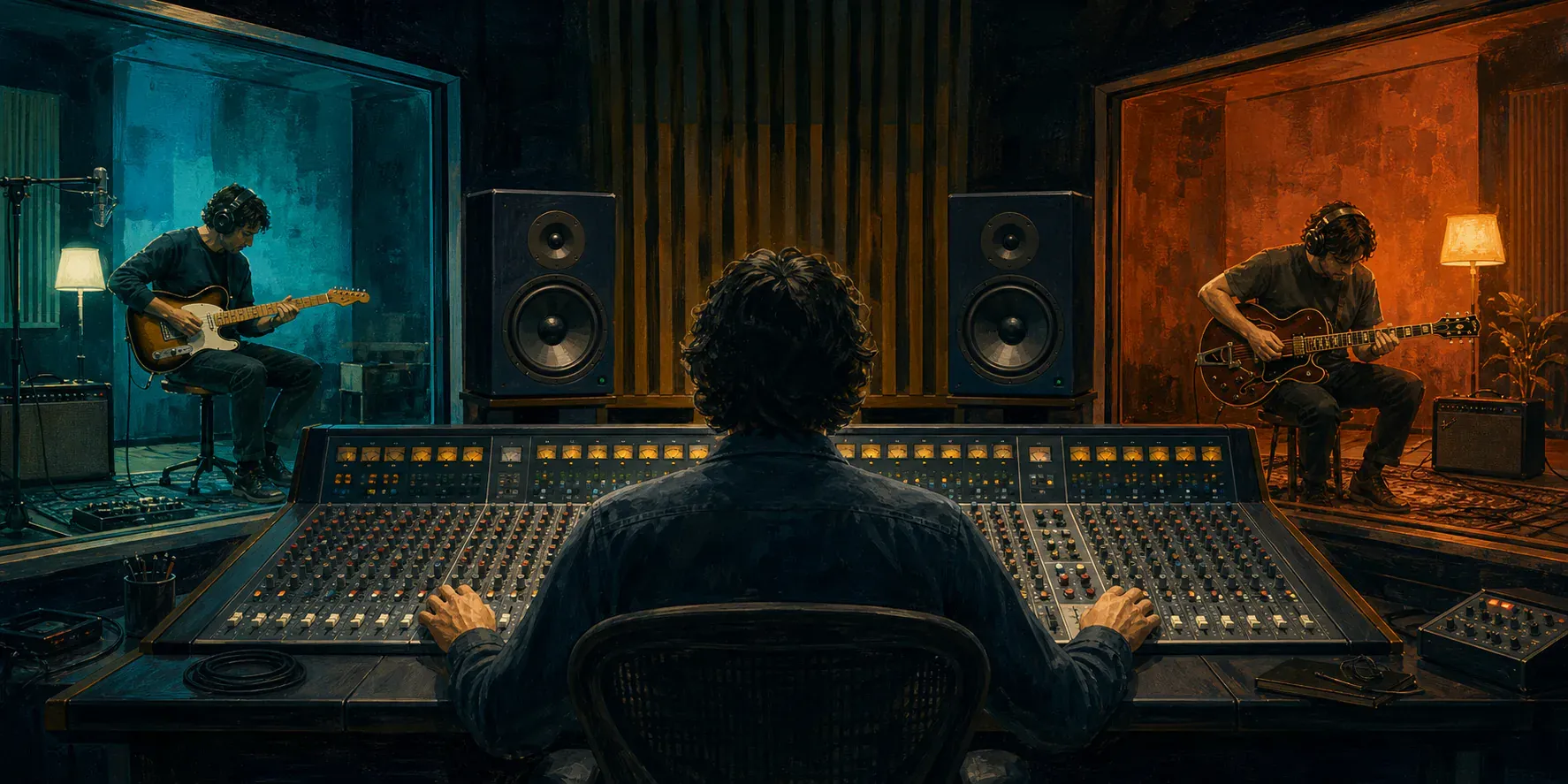
- 1Take one attack
- 2Small timing difference
- 3Take two attack
- 4Opposite pan positions
- 5Mono sum check
The offset changes from note to note. A fixed copied delay produces a different relationship.
Mono, polarity, and playback outside the studio
Mono combines left and right. Two performances will interfere, but because their timing and pitch differences change continuously, the cancellations also change. The sum may sound narrower, rougher, or slightly lower than the impressive stereo pair without being defective. The question is whether the riff, balance, and song survive.
Use a real mono control or a utility device that sums channels rather than moving closer to one speaker. Ableton’s Utility documentation provides controls for channel and width management that can support this check. [#ableton-utility] Lower monitor level after summing, because central energy can change. Listen to guitar against vocal and snare, not only by itself.
Do not flip polarity at random. Polarity inversion can help when two microphones capture one source with opposite electrical or acoustic relationships. Independent takes contain no single polarity state that aligns every event. A switch may make one chord fuller and the next thinner. Keep it only if the full song improves across playback conditions.
Check one earbud, a phone speaker, a small mono radio, headphones, and speakers if the release warrants it. Katz’s mastering practice emphasizes translation and calibrated judgment across systems. [#katz-mastering] A pair that loses a little width in mono is expected. A chorus whose guitar disappears under vocals needs a mix decision.
Sound On Sound’s acoustic-guitar guidance notes that opposition-panned double tracks can sink in mono and recommends compatibility checks. [#sos-acoustic] The session report on guitar tracking also shows why a production might choose split amplifiers or a short delay when a player cannot deliver a consistent second performance, while acknowledging different mono risks. [#sos-session-guitars] Name the method honestly and test its actual failure mode.
Practice: record two takes and audit the result
Choose a two-bar part with one rest and one sustained chord. Record take one to a click and drum loop. Record take two without seeing take one’s waveform. Tune before both and keep the same guitar setup. Pan them left and right. Write down three observations about attacks, three about note endings, and one about pitch movement before editing anything.
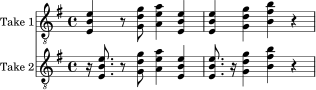
Use the explorer to switch the two notated voices independently. The example exaggerates a few offsets enough to make the principle visible, while its static score preserves the comparison without JavaScript.
Interactive score
Two performances, one part
Switch two independently written takes on and off. The second enters with small timing differences. Playback begins only when you press Play.
Loading the optional player…
Make three mixes: take one centered, two takes panned halfway, and two takes panned wide. Match perceived loudness. Compare rhythmic definition, center space, and edge movement. Then sum each to mono. Keep notes on the song function, not a generic score for width. The centered take may be best for a verse even if the wide pair wins in the chorus.
Create a copied-delay version from take one and compare it with the real pair. Use a short fixed delay, then a modulated treatment. Notice whether the image pulls toward the earlier side, whether the center changes in mono, and whether every note carries the same relationship. This comparison makes the terms audible: duplicate, fixed-delay widening, ADT-style modulation, and performance double tracking.
Finally edit only the two clearest problems in the real pair. Recheck whole sections with the screen hidden. If the riff reads and the sides retain small independent motion, stop. The aim is not visual symmetry. It is a pair of performances whose differences support width while their shared decisions support the song.
Lab one: measure attacks without worshiping the grid
Record eight bars of muted eighth notes twice. Place markers at the first attack of each bar and measure the difference between takes. Then measure three internal attacks per bar. The values should vary. A consistent fixed number would resemble a delayed copy; real performance produces a distribution shaped by the player’s anticipation, fatigue, and phrasing.
Listen before deciding which numbers are too large. At 100 beats per minute, ten milliseconds is a small fraction of an eighth note, but a sharp muted transient can make it obvious at the stereo edge. A sustained chord may tolerate more. Circle only offsets that create an audible flam or weaken a unison with drums.
Move one circled attack halfway toward the reference rather than aligning it completely. Compare with the untouched and fully aligned versions. The intermediate edit often restores the riff while retaining lateral motion. Repeat for a late note ending. This teaches editing as a proportional musical decision.
Lab two: pitch and intonation across the neck
Tune open strings, then check the fretted notes used in the part with ordinary playing pressure. A guitar can show accurate open tuning while a stiff grip pulls chords sharp. Record sustained unisons at low, middle, and high positions in two takes. Listen for the speed and stability of beating when the tracks are panned together and summed to mono.
If one region is consistently unstable, inspect setup and fingering before using pitch correction. Check intonation, string condition, fret pressure, and whether one take uses a different chord inversion. Correcting a complex distorted chord after recording can create artifacts while leaving the underlying performance inconsistency unexplained.
Try a deliberate contrast with one take on a different pickup. Match level and pan. The spectral separation may make the pair clearer, but it may also pull the image toward the brighter side. Restore matched pickups and compare. Choose the contrast because the arrangement benefits, not because difference is always width.
Lab three: gain staging for one, two, and four takes
Set an amplifier tone for one guitar in the full mix, then record two performances. Do not change the amp between them. When both play, note whether pick attack, chord pitch, and rests remain clear. Lower preamp gain and repeat. Match output loudness so saturation is the variable rather than volume.
If the lower-gain pair sounds larger, identify why: more transient contrast, less continuous fizz, clearer bass separation, or more stable chord centers. Add a third and fourth performance only for one section. Place the extra pair closer to center or lower in level. Quad tracking is not simply double tracking made twice as good; it changes density and can reduce the importance of any single attack.
Automate layers by form. One centered take may carry a verse, a wide pair may open a chorus, and a quieter inner pair may enter only at the ending. This makes width an arrangement event. If all four tracks run continuously, their novelty disappears and the mix has fewer places to grow.
Lab four: acoustic guitars and microphone identity
Record one acoustic performance with one microphone, then repeat the part. Pan the takes apart. Because each performance contains new string, pick, and body resonances, the pair can sound broad without a stereo microphone technique. Keep microphone and chair fixed so performance remains the main variable.
Now record one performance with two microphones and pan those channels. This is not double tracking. Move one microphone slightly and hear how the fixed phase relationship changes tone, especially in mono. Return both microphones to one pan position and build a usable mono blend before treating it as one side of a later double.
For a dense arrangement, reduce low-frequency body on the guitar pair only after bass and kick return. For a sparse arrangement, preserve enough body that wide panning does not leave an empty center. The same method serves different roles depending on what else occupies the spectrum.
Lab five: center, half-wide, and hard-wide
Print three matched-loudness mixes. In the first, place both takes near center. In the second, pan them halfway. In the third, use the extremes. Listen from the center, then stand near one speaker. Hard panning makes each performance more exposed away from the ideal seat; moderate panning lets both speakers contribute to each side’s impression.
Add a lead vocal and note consonant clarity. If centered guitars compete, wider placement may clear space without EQ. Add a stereo reverb and check whether its returns refill the center or exaggerate the edges. Reduce the send before changing guitar panning.
On headphones, judge whether extreme separation feels disconnected. A shared short room or moderate pan may make the pair belong to one performance space. On speakers, room crossfeed already connects the sides. Make the decision across both rather than mixing only for the most spectacular headphone width.
Lab six: mono failure diagnosis
Sum the pair and identify the failure precisely. If overall level drops modestly but the part remains clear, compensate only if the song balance needs it. If one chord becomes thin, inspect tuning and the local performance. If the entire spectrum becomes hollow, check whether the tracks are actually copied or whether a fixed-delay treatment is present. If rhythm blurs, inspect attack and release differences.
Mute effects and sum again. Stereo wideners, short delays, and certain reverbs may create more cancellation than the performances themselves. Restore processors one at a time. This order prevents unnecessary edits to good takes.
Compare the mono pair with the chosen single take. A production may deliberately switch to one centered guitar for a section that must translate with maximum focus. Mono compatibility is not a demand that every stereo detail remain unchanged. It is a check that the musical hierarchy, intelligibility, and intended impact survive another playback condition.
Lab seven: double clean arpeggios
Choose an arpeggio that lets adjacent strings ring. Write fingering and decide exactly which notes overlap. Record two takes with a clean tone. Small differences in release now matter more than distortion texture: one ringing open string can extend harmony on only one side.
Compare hard panning with moderate panning. If the arpeggio feels like two competing parts, bring the sides inward or reduce one take during vocal lines. Add a short shared room and listen for whether reflections connect the performances or blur individual notes.
Edit one unwanted overlap by shortening the note rather than moving its attack. This demonstrates why onset alignment solves only one dimension. Recheck the chord’s internal voice leading. A doubled arpeggio works when both takes agree on harmonic intention while retaining small differences in touch.
Lab eight: separate rhythm and color doubles
Record the main part twice with matched equipment. Then record a third performance an octave higher or with a different inversion. The third track is not another exact double; it is an arranged color layer. Label it accordingly and keep it lower until its notes are felt as contour rather than a new lead.
Mute the color layer in verses and introduce it in the final chorus. Compare that change with simply raising the main pair. New register can create growth without more low-mid density. Check whether the inversion adds chord tones that conflict with voice or bass.
In production notes, distinguish performance count from part count. Four tracks may contain two takes of one rhythm part and two takes of another. Calling the result quad tracking without explanation hides the arrangement. Clear labels make editing and credits more accurate.
Lab nine: reamp the same pair responsibly
Use the clean DI from both performances and send each through the same reamp chain. Match level into the amplifier and record microphone position. The performances remain different even though the tone path is shared. Pan and compare with the original amp captures.
Next change the cabinet or microphone for both takes. This tests a tone decision without changing performance. Avoid reamping one side through a bright chain and the other through a dark chain until the matched comparison is understood; asymmetry can alter apparent level and localization.
Keep original DI, reamp outputs, and timing aligned from one session start. Print a note about latency compensation rather than moving files by eye. If a stable reamp offset is present, correct both sides consistently. Do not remove the changing timing differences between performances.
Lab ten: audit the arrangement at three scales
At the note scale, inspect attacks, releases, pitch, and muting. At the section scale, compare width, density, and transition energy. At the song scale, ask where double tracking enters, leaves, or changes role. A pair can be excellent locally while making the whole song permanently wide and unable to grow.
Print a map with one line per guitar part and shade only the bars in which it plays. Mark pan position and register. Crowded passages become visible without inspecting waveforms. Remove the least necessary layer from one chorus and compare impact; subtraction may make the main pair more legible.
Finish at normal listening level and without solo buttons. The release will be heard as a song, not a guitar demonstration. Keep the double when it strengthens rhythm, harmony, or form. Use one take when focus matters more. The method is valuable because it offers controlled human variation, not because every guitar must occupy both edges.
Lab eleven: double around a lead vocal
Loop a verse and place one guitar take in the center beneath the vocal. Balance words, snare, and guitar before adding the second take. Then pan the pair moderately and compare consonant clarity. Width may solve masking by relocation, but a bright pair can still compete across both sides.
Automate guitar level between vocal phrases instead of applying one deep EQ cut to the whole section. In the chorus, try hard panning and a broader vocal stack. Map which layer creates growth. If guitars, vocals, and effects all widen simultaneously, the center may lose focus even while the meters look balanced.
Lab twelve: intentional mismatch
Record the second take with a different chord inversion only in the final chorus. Check every added pitch against bass and voice. The result is arranging, not strict double tracking, so label the track by function. Pan and level it as a harmony part rather than assuming symmetry.
Try a capo or alternate tuning for the color take. Different open strings change sustain and beating. Keep the main pair intact so the listener retains the song’s rhythmic frame. Mute the color part during the final mix check; if nothing changes, it is not earning its density.
Lab thirteen: performer fatigue
Record the first and last complete take of a session and compare pick depth, tempo placement, muting, and noise. Fatigue can make a player rush, drag, grip harder, or shorten notes. More takes do not guarantee a better pair.
Schedule breaks, retune, and replay a short reference before continuing. Select takes from musical consistency rather than chronology. If the first take has energy and the later take has cleaner stops, a careful composite may be justified, but preserve complete phrases where possible.
Lab fourteen: document the method
Write whether each track is a separate performance, copied delay, ADT-style treatment, reamp, or multi-microphone capture. Include performer, instrument, tuning, take number, signal path, pan, and important edits. This prevents a future mixer from trying to align independent takes or treating two microphones as two performances.
Export labeled stems from one common start and retain dry tracks when rights and storage allow. Add the static score or chord chart. Documentation turns an impressive stereo effect into a reproducible production decision and makes credits more accurate.
Lab fifteen: final blind comparison
Print single, real double, copied delay, and modulated ADT-style versions at matched loudness. Randomize names and ask listeners about rhythmic clarity, center stability, width, mono translation, and preference. Do not ask which sounds professional; the word contains no mechanism.
Reveal methods only after notes are complete. Preferences may change by section and playback system. Keep the version that serves the song’s hierarchy. The blind pass is not a scientific trial, but it reduces attachment to the most laborious technique and makes the final choice accountable to audible results.
Lab sixteen: double a part with rests
Write a phrase in which silence occupies half of every second bar. Record both takes and listen to the rests before the attacks. One guitarist may release later, leave amplifier hum, or brush a string. Decide whether the pair should produce complete silence or a controlled residue of performance.
Edit note endings first. Use fades that preserve pick and mute character, then compare a bus gate. A gate can make both sides close together, but it may also turn changing human releases into one mechanical envelope. Choose based on the song’s language of stops.
Add drums whose cymbal tail crosses the guitar rest. The ensemble is not silent even when guitars are. This distinction prevents unnecessary noise removal and keeps attention on which layer is supposed to breathe.
Lab seventeen: check the low end
Double-tracked guitars can mask bass even when panned wide because low frequencies from both speakers combine in the room. Listen with bass and kick at low monitor level. If their pitch or transient disappears, reduce guitar gain or low-mid density before boosting the rhythm section.
Compare high-pass filtering, a different chord inversion, and shorter palm muting. The arrangement or performance change may solve the overlap more naturally than steep EQ. Keep enough guitar body that the pair does not become detached fizz.
Walk around the room. Standing waves change low-frequency balance far more than a small fader move. Confirm on headphones and another room before printing a corrective curve based on one listening position.
Lab eighteen: hand the session to another mixer
Provide labeled takes, a rough mix, tempo information, tuning, DI tracks, notes about intentional timing, and a list of comp edits. State which effects are essential and which were only monitoring. Do not flatten all processing into audio unless recall or rights require it.
Ask the mixer to identify performance pairs before reading your notes. If labels are clear, they should not confuse copied tracks, microphone pairs, or harmony parts with double tracking. Correct the archive rather than relying on oral explanation.
Compare the returned mix with the rough at matched loudness. Discuss width, center, rhythmic definition, mono behavior, and form. A handoff tests whether the production idea is documented well enough to survive outside the original room.
Lab nineteen: decide when not to double
Mute the right take during a dense verse. Center or moderately pan the remaining guitar and rebalance it without raising overall loudness. Listen for improved vocal space, clearer bass pitch, and a more singular pick attack. A narrower section can make the next wide chorus feel larger than constant double tracking does.
Try one performance for a syncopated bridge where guitar must interlock with bass. If the second take makes the rhythm less certain, leave it out or use it only on sustained endings. Production consistency is not a requirement that one method occupy every bar.
Compare emotional address. One exposed performance can feel close and vulnerable; two can feel collective, controlled, or monumental. Those descriptions need support from the actual arrangement, but they remind the engineer that width has narrative consequences as well as technical ones.
Document the omission in the track map. The absence of a second take is an arrangement decision, not unfinished work. Double tracking is most effective when the song contains a credible alternative to it.
Make a final export with the single section and the doubled section adjoining each other. Listen across the boundary on speakers, headphones, and mono. Match musical energy rather than waveform height. If the wide entrance feels smaller, inspect gain accumulation, low-mid masking, and note length. If it feels disconnected, share a room return or bring the pans inward. Keep the transition only when it clarifies form without requiring the listener to admire the technique itself. Archive this comparison with the mix notes so the mastering engineer knows that the width change is intentional.
Static score: two related performances
Source details follow the article.