
Follow the phrase
A bassline is not every low sound in a recording. It is a part with an order: one note leads to another, a rest interrupts the pattern, and repetition establishes expectation. The line may outline harmony, answer another instrument, or function as the most memorable melodic shape in the arrangement.
In a vocal reggae record, words and melody can draw attention away from that design. A version changes the hierarchy. Once the lead voice is absent, the listener has time to notice that a bass phrase may contain its own beginning, turn, and return. Dub can thin the arrangement further until the line is almost alone. The bass then carries memory of parts that are no longer sounding.
Michael Veal’s study of dub describes drum and bass as a structural backbone, but the metaphor should not suggest immobility. A backbone bends. Jamaican bass playing uses syncopation, anticipation, rests, held notes, register changes, and variations at phrase endings. Its authority comes from an organized sequence, not from occupying the lowest frequency continuously. 2
Low pitch is only one part of bass identity
The fundamental is the lowest periodic component of a note, yet a bass instrument also produces harmonics above it. Those upper components reveal the attack, finger or pick noise, fret contact, amplifier character, and the pitch of notes that small loudspeakers cannot reproduce fully. A phone may remove much of the fundamental while leaving enough harmonic evidence to follow the phrase.
This is why “more bass” is an imprecise production request. It can mean a louder bass guitar, stronger fundamentals, a heavier kick, more low-mid body, longer note sustain, or less competition from other instruments. Each change produces a different result. A simple level boost may make the line dominate without making its notes easier to distinguish.
The source instrument matters as well. String condition, plucking position, muting, pickup choice, amplifier, cabinet, microphone, and direct signal change the balance of attack and sustain. Flatwound strings and palm muting can shorten and darken a note, but there is no single mandatory reggae setup. The recorded line is the product of a player, an arrangement, and an engineering chain.
Sound On Sound’s mixing guidance recommends judging bass in relation to the whole track and controlling overlapping low-frequency parts rather than boosting indiscriminately. That general principle is especially relevant to dub because sparse passages expose problems that a full arrangement might mask. 3
A bass phrase can imply harmony without stating every chord
Many bass lines outline roots, but root does not mean “the first beat of every bar.” A player may approach a root from above or below, delay it, hold a previous pitch across a chord change, or leave the change unstated until later. Passing notes connect stable tones. Neighbor tones depart and return. Octave displacement changes register without changing pitch class.
Remove guitar and keyboard from a version and these choices become exposed. If the bass lands clearly on a root while harmony instruments are absent, the listener can infer the chord. If it emphasizes the fifth or a passing tone, the harmony becomes temporarily ambiguous. The return of an organ bubble or guitar skank can resolve that uncertainty without the bass changing at all.
Do not reduce the line to chord symbols too early. Sing its contour first. Note where it climbs, where it repeats, and where it stops. Then compare the phrase to the harmony. This order prevents a common analytical mistake: describing only which chord each note belongs to and missing the rhythm that makes the line recognizable.
Rests give a sound system room to speak
Silence inside a bass phrase is active. It allows the kick transient to appear without a simultaneous sustained note. It leaves space for a deejay’s consonants. It prevents a small room or resonant speaker enclosure from accumulating uninterrupted low-frequency energy. Most importantly, a rest creates expectation for the next entrance.
The length of the previous note matters as much as the rest itself. A note that is stopped cleanly before beat one produces a different pocket from a note whose release overlaps the kick. Muting can come from either hand, the instrument’s setup, a gate, an edit, or a fader, but the audible question is the same: where does the pitched energy end?
Lloyd Bradley’s history makes bass inseparable from the social and physical experience of reggae in Jamaica and Britain. Large systems turned low frequency into shared pressure, while records, selectors, and crowds established what worked in a dance. 4
That environment does not justify unsafe playback. Hearing damage depends on level and duration, and increasing volume is not a substitute for adequate low-frequency response. For close listening, use a moderate level. Feel for entrances if the system permits it, but follow rhythm through upper harmonics when it does not.
Bass and kick negotiate rather than duplicate
The instruction to “lock bass with the kick” is useful only if lock is understood as a relationship. Some attacks coincide and reinforce each other. Others alternate. A bass note may begin after a kick, sustain across the next one, or stop immediately before it. Complete duplication can create force, but it can also remove the conversational motion between parts.
Map one bar with two rows. On the upper row, mark kick attacks. On the lower, mark bass attacks and draw the duration of each note. Coincident marks reveal reinforcement; unmatched ones reveal independence. Repeat for four or eight bars, because a fill or turnaround may change the relationship at the phrase boundary.
Frequency overlap complicates the pattern. A kick may carry a low fundamental plus a shorter high-frequency click. A bass note may begin with a transient and settle into a sustained fundamental. Equalization and compression can separate or merge them. The choice is not simply which instrument owns one frequency. Envelope, timing, and pitch all affect whether listeners perceive one combined impact or two events.
The classic Jamaican session rhythm section included many individual approaches. Family Man Barrett, Robbie Shakespeare, Lloyd Parks, Flabba Holt, Boris Gardiner, and other bassists did not produce one interchangeable reggae line. Drummers likewise brought distinct kick placement, snare tone, ghost notes, fills, and cymbal use. David Katz’s oral history is valuable because musicians and producers describe these working differences from inside the sessions. 5
#
One drop, rockers, and steppers distribute weight differently
Terms for reggae drum feels are descriptive conventions, not immutable scores. In a one drop pattern, the kick and snare or rim emphasis commonly lands on beat three while beat one is left comparatively open. A steppers pattern places the kick on all four quarter notes. Rockers is used for patterns with a more active bass-drum motion, though musicians and writers do not always draw its boundary identically.
The same bass phrase feels different over each approach. Against one drop, an early bass attack can occupy beat one without a kick underneath it. Against steppers, every quarter note supplies a low drum anchor, so bass syncopations weave around a more explicit floor. Against a busier kick pattern, short bass rests may be necessary to keep individual attacks legible.
Listen to the hi-hat or ride after identifying kick and bass. Eighth-note, sixteenth-note, or triplet subdivisions change the space between low-frequency events. Percussion and guitar may articulate still another layer. The groove is a set of interlocking durations, not a two-instrument diagram.
The rhythm track became reusable material
A successful Jamaican rhythm could support several singers, deejays, instrumentals, versions, and later revivals. Reuse lowered the cost of producing another side, but it also created a listening culture in which audiences recognized accompaniment across different records. The rhythm acquired an identity apart from any single vocal.
The Marr Sound Archives describes version practice on B-sides within the competitive Kingston studio and sound-system economy. Demand for new and exclusive material encouraged engineers to remove vocals and reorganize existing tracks. 6
This history differs from a modern remix commission in which an outside artist receives stems after a release. Jamaican versions could be part of the record’s expected working life from the start. A deejay might voice the same rhythm, a horn player might carry the melody, or an engineer might reduce it to drum, bass, and effects. The order varied, and the label did not always document every connection.
Version does not automatically mean dub. A relatively straight instrumental backing can leave the rhythm intact for a deejay. A dub may perform more radical subtraction, filtering, echo, reverb, and feedback. The boundary is historically flexible, but the distinction helps listening: first ask what material was reused, then ask how strongly the mix transformed its arrangement and space.
Dubplates moved versions directly into the dance
A dubplate is a disc cut individually on a lathe rather than manufactured as part of a normal pressing run. The familiar name can obscure the material: many historical plates have an aluminum core covered with a softer lacquer. They can be played immediately after cutting, which made them useful for auditions, tests, and exclusive sound-system use.
Ray Hitchins explains that tape had replaced acetate as the main studio recording medium, but the disc retained a particular advantage for Jamaican sound systems: a fresh first-generation cut could move material from studio to dance without waiting for a commercial pressing. 7 Speed mattered in a competitive market. A selector could test an unreleased rhythm, and the crowd’s response could inform later decisions.
The format also imposed limits. Lacquer wears with repeated playback, especially under heavy tracking force or poor handling. Cutting level, groove spacing, duration, and bass content must be balanced. A loud low-frequency signal demands physical movement from the cutting stylus and playback cartridge. The disc is therefore not a transparent container for unlimited bass. The cutting engineer helps translate weight into a playable object.
This material history distinguishes a dubplate from a playlist file labeled “exclusive.” Digital distribution can preserve exclusivity by agreement or controlled access, but it does not reproduce the wear, one-at-a-time cutting, and proximity to a lathe that shaped the older object. Neither format is inherently more authentic. They organize scarcity and circulation differently.
#
Specials turn a familiar song toward one sound
A special usually contains newly recorded vocals that identify or praise the commissioning sound, challenge rivals, or adapt a known lyric to clash conditions. The familiar melody and rhythm allow an audience to recognize the underlying song while the changed words announce exclusive access. Recognition and difference arrive together.
Kim Ramstedt’s study of a Finnish sound’s commissioned Max Romeo special shows that this practice persisted through digital production. His analysis complicates the idea that a recording’s aura depends only on an analog object. The value also comes from the artist’s address, the commissioning relationship, restricted circulation, and performance context. 8
A special is not synonymous with an instrumental version or a dub mix. It may contain a full vocal, and its distinction can lie primarily in the rewritten name checks. A dubplate describes the individually cut medium or, by extension, exclusive sound-system material. A version describes reuse of a rhythm. A dub describes a transformative mixing practice. In everyday speech the terms overlap, but keeping their main functions separate prevents confusion.
David Rodigan’s account of work at King Tubby’s describes vocal and dub passes being cut from multitrack tape as live operations. It also shows why possession mattered: the plate carried a mix another selector did not have. 9 Exclusivity was audible when the selection differed, not merely asserted in publicity.
Version economics rewarded a durable rhythm
Recording a band required musicians, a room, engineering, tape, rehearsal, and time. Voicing an existing rhythm could require fewer people and less setup. A producer who controlled a strong backing therefore possessed an asset capable of supporting several issues. This economy encouraged reuse, but the result should not be mistaken for effortless duplication.
Each new vocal needed arrangement judgment. The singer’s range might expose a harmonic problem. A deejay needed openings for speech. A horn instrumental could require space in the register formerly occupied by voice. A dub mix needed access to grouped tracks and an engineer able to perform them. Reusing the rhythm moved labor rather than eliminating it.
Norman Stolzoff connects this production system to dancehall’s institutions and roles. Sounds demanded material; producers and studios supplied it; deejays created new performances; audiences evaluated the results in public. 10 The loop between dance and studio was economic and aesthetic at once.
Successful rhythms could outlive the equipment and business arrangements that produced them. Later musicians might replay a pattern rather than license the old master. Digital programmers could reconstruct its accents with samples and synthesizers. New singers could voice it for another generation. At each stage, “the same riddim” may mean the same master, a derived mix, a replay, or a recognizable compositional pattern. Discographical claims need to specify which.
Steve Barrow and Peter Dalton’s reference history is useful for following recordings, musicians, producers, and stylistic periods without treating reggae as one unchanging sound. 11 A rhythm revived in dancehall can keep its melodic outline while its drum timbre, bass source, tempo, and mix density change.
Different version practices make different listening contracts
A B-side version paired with a vocal single invites immediate comparison. The listener can turn the record over and hear what was removed. A deejay version places a new voice over the rhythm and shifts authorship toward verbal performance. A horn cut promotes an instrumental melody. A dub album collects transformations into a sustained listening sequence. A sound-system special addresses a particular crew and event.
Those formats ask different questions. The B-side may demonstrate the record’s internal construction. The deejay cut tests how speech rides the groove. The horn cut tests whether the accompaniment supports another lead register. The dub album tests how far several rhythms can be reorganized without the original vocal sequence. The special tests social recognition in performance.
Michael Veal’s history treats dub as part of this broader Jamaican continuum rather than an isolated electronic invention. 12 That placement matters: the spectacular echo burst makes more sense after the ordinary availability of versions has already taught listeners to hear a rhythm apart from its first song.
The mixer protects the bass by removing competition
Low-frequency clarity often improves when something is taken away. A keyboard’s lower notes, a guitar’s cabinet resonance, reverberation, tape noise, and the body of a vocal can all occupy the range in which bass harmonics communicate pitch. High-pass filtering those sources does not automatically solve the problem, but it demonstrates that bass weight depends on the spectrum around the bass as well as on the bass channel itself.
Dub makes this relationship audible through sudden contrast. When harmony tracks vanish, the bass may appear larger although its fader has not moved. When they return, the same line seems to recede. Level is unchanged; masking has changed. This is one reason a dub mix can feel as if the bass is being boosted constantly even when much of the drama comes from subtraction elsewhere.
Reverb requires particular care. Low frequencies persist in a long tail and can obscure the next note. Filtering an effects return leaves the dry bass powerful while keeping echoes and reverberation legible above it. A mixer can also avoid sending bass to the effect except for selected transitions. Sound On Sound’s dub-mixing account describes this use of sends, returns, filters, and mutes as a performed system rather than a fixed ambience. 13 16
Compression changes the envelope instead of merely changing tone. A slow enough attack can preserve the start of a note before gain reduction acts on its sustain. A fast attack can restrain that onset. Release determines whether gain returns before the next note. The proper setting depends on the phrase; there is no reggae ratio that works without listening.
Side-chain compression, common in later electronic production, can reduce bass level each time the kick sounds. That creates space automatically but does not reproduce every Jamaican bass-and-drum relationship. If bass and kick are meant to combine on the same attack, heavy ducking can remove the desired weight. Use it as one modern option, not as a historical explanation.
Mono changes the meaning of width
The core rhythm has to survive reproduction systems that do not preserve a wide stereo image. Low frequencies are difficult to localize partly because wavelengths are long and because rooms strongly reshape them. Vinyl cutting also discourages large out-of-phase low-frequency information. Keeping bass near the center provides a stable foundation while higher percussion, guitar, keyboards, horns, and effects can create lateral motion.
This does not mean every historical reggae record is perfectly mono below a fixed modern crossover frequency. Tape transfers, stereo effects, microphone leakage, mastering, and reissues complicate the signal. It means that a wide bass effect should be checked when channels combine. If left and right contain opposing waveforms, summing them can reduce the note rather than reinforce it.
Perform a mono check at matched loudness. If bass pitch remains but the apparent size shrinks, some width was contributing to the impression. If particular notes nearly disappear, inspect phase relationships and room interactions. If nothing changes except the side effects, the central rhythm is doing its job.
A sound system is an arrangement of labor
Speaker stacks receive much of the visual attention, but a functioning sound also needs transport, setup, power, cabling, maintenance, record storage, selection, microphone work, security, promotion, and a place to operate. The bass heard in the dance depends on that labor. A failed amplifier or badly matched enclosure can undo decisions made in the studio.
Norman Stolzoff’s institutional account is important because it keeps the audience in the system. The crowd does not simply receive a neutral playback. People respond, request, move, leave, compare sounds, and remember selections. The selector reads that behavior and changes course. Recorded bass becomes part of a feedback loop between music and public judgment.
The same track can work differently outdoors, in a concrete room, or in a small club. Boundaries reinforce some low frequencies and cancel others. Standing near a wall can change the balance. Moving a few steps may reveal a note that seemed absent. These room effects are not reliable evidence of what is printed on the record.
For critical listening, compare positions before blaming a mix. Use a familiar reference at the same level. In a venue, judge patterns across the floor rather than from one bass hotspot. At home, avoid placing every low-frequency conclusion on headphones alone; they remove room modes but also remove the physical interaction between system, room, and body.
British bass culture adapted Jamaican version logic
Migration carried records, sound-system knowledge, musicians, selectors, and audiences to Britain. Caribbean communities created dances and distribution networks under local conditions that included racism, policing, housing pressure, and limited access to mainstream venues. Bass culture there was not a replica of Kingston. It developed through British rooms, equipment, labels, and political conflicts.
Dick Hebdige follows Caribbean musical practices through questions of identity in Britain, while Paul Sullivan traces dub’s movement into later production cultures. 14 15 Together they show why influence is better understood as transmission and adaptation than as a list of genres that borrowed echo.
Lovers rock, British roots reggae, dub poetry, post-punk experiments, jungle, drum and bass, garage, grime, and dubstep each organize voice and low frequency differently. Some retain a direct relationship with reggae sounds. Others inherit methods through several intermediate scenes. Calling all of them dub would erase those histories, but ignoring the version and sound-system lineage would erase a major part of how British bass music developed.
The technical vocabulary also shifts. A later producer may build a bass part from a sine wave, sampler, or synthesizer rather than bass guitar. A digital riddim may exist without a live session tape. Versions can be exported instantly and recalled exactly. Yet the question remains recognizable: can one rhythmic foundation support several voices, identities, and public uses?
Digital versions alter scarcity and recall
Digital audio workstations make every track individually available until the producer chooses to commit it. Automation can reproduce fader and send moves precisely. Unlimited undo permits experimentation without sacrificing the earlier state. These capacities are useful, but they change the performance pressure associated with mixing a four-track tape to a one-off disc.
A modern dub can restore some contingency by limiting controls. Route instruments into four groups, assign a small number of sends, and perform a complete pass from beginning to end. Do not edit immediately. Listen to the result as a performance. The constraint is an exercise, not a claim that old equipment is superior.
Digital files also separate the idea of a dubplate from lacquer. A special can remain exclusive through private delivery and agreement even though it can be copied perfectly. Its value rests more visibly on trust, artist access, naming, and the moment of deployment. Ramstedt’s research shows that digital remediation does not simply destroy the older practice; it reshapes how uniqueness is produced and understood.
Recall changes version economics. A producer can open the session, mute the lead vocal, and export an instrumental in minutes. That convenience may create a useful version, but it does not guarantee a musically reorganized dub. Transformation still requires choices about sections, entrances, space, filtering, and the balance of drum and bass.
A staged listening method
Begin with ordinary speakers at moderate level. First, tap the pulse without identifying notes. Second, sing the bass rhythm on one syllable. Third, trace pitch direction. Only then write note names if that helps. This order works when playback does not reproduce the lowest fundamental clearly.
Next compare bass and kick. Mark shared attacks, bass-only attacks, and kick-only attacks. Listen to duration: does the bass cross the kick, stop for it, or begin after it? Repeat at the end of the phrase, where fills often disturb the regular pattern.
Now remove or mentally ignore harmony. Ask how much chord information the bass retains. Restore the full mix and notice whether guitar or keyboard masks the line. If an official version exists, compare it with the vocal record at matched loudness. Avoid treating a remaster’s overall level as an arrangement difference.
Finally follow one disappearance through a dub. What is removed? What remains to imply the pulse? Does an echo continue after its source? When the bass returns, is it on a phrase boundary or at an unexpected point? The answers describe the mix more precisely than saying that the drop feels heavy.
Common listening errors
The first error is following only the deepest sensation. Room modes can make one note shake the furniture while the next nearly disappears, even when their recorded levels are similar. Identify rhythm and pitch through harmonics before ranking notes by physical force. Move position, reduce volume, and compare headphones if the pattern seems implausibly uneven.
The second error is assuming that bass and kick always coincide. This turns two parts into one imagined sequence and hides syncopation. Track attacks separately. A kick can define the beat while bass enters between beats; bass can sustain while the kick adds a new transient; either part can leave a hole that the other occupies.
The third error is describing every instrumental backing as dub. Some versions change little beyond removing the vocal. That does not make them unimportant. Their openness can support a deejay, expose the rhythm, or prepare another issue. Reserve more detailed dub language for what the mix actually does: performed mutes, transformed sections, filter movement, selective sends, feedback, and changing depth.
The fourth error is treating bass weight as proof of a particular piece of equipment. Instrument, player, arrangement, tape, console, equalization, compression, cutting, pressing, playback cartridge, amplifier, enclosure, room, and transfer can all change the result. A convincing gear claim needs documentation. Sound alone usually supports a more modest description.
The fifth error is forgetting duration. Two lines can use the same pitches and attacks but feel different because one player stops notes earlier. Write horizontal marks for sustain as well as dots for onset. The resulting page resembles the groove more closely than standard notation stripped of articulation.
Build a version without losing the song
Interactive score
Bass, kick, and harmony
Switch the foundation parts independently and compare what survives subtraction. Playback begins only when you press Play.
Loading the optional player…
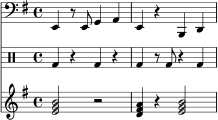
Use the six-layer explorer attached to the related dub article or choose a multitrack session you have permission to edit. Start with the full arrangement. Identify the fewest parts needed for recognition. In many reggae arrangements those will include bass, a drum pattern, and one harmony or melodic cue, but do not assume the answer in advance.
Mute the lead melody or vocal. Let the rhythm play for sixteen bars without effects. If the version becomes directionless, listen for why. The bass phrase may not mark the end of the section; a harmony cue may be carrying the change; a drum fill may have been hidden. Restore only the missing signpost rather than the entire arrangement.
Next make one contrast through subtraction. Remove harmony for four bars, but keep bass and drums stable. On the repeat, remove kick while bass continues. Compare the two gaps. The first exposes tonal and rhythmic space around the foundation. The second weakens the impact grid and makes bass duration more conspicuous.
Add one delay return. Send a single chord or rimshot, then close the send. Keep the bass dry. If the repeat covers the next phrase boundary, shorten its feedback or filter it more strongly. The goal is to hear an answer, not to demonstrate that a delay plug-in is running.
Perform the complete version in one pass. Move only group faders and the one send. Record the result. On playback, mark moves that landed late, passages where the foundation was lost, and returns that felt prepared by silence. Make a second pass, changing only those moments. This creates a practical distinction between composing a plan and performing it.
How bass preserves identity during radical subtraction
A listener recognizes a song through several possible cues: words, melody, harmonic progression, timbre, rhythm, and form. Dub can remove the two most obvious cues, lead voice and melody, while keeping identity intact. The bass line is often responsible because it combines pitch order with a highly specific rhythm.
Repetition strengthens that role. Once a phrase has cycled several times, the listener predicts its next entrance. The mixer can withhold part of it and let expectation complete the gap. When the full line returns, recognition feels stronger because memory has been active during the absence.
Variation prevents the foundation from becoming mechanical. A bassist may alter the last note before a new section, shorten a sustain under a fill, climb into a turnaround, or leave an extra rest for the vocal. These changes help map form. A dub mixer who knows the track can preserve a tiny variation while removing larger parts, allowing the rhythm section to announce the transition alone.
This is why bass transcription should include multiple cycles. One bar may show the basic cell but miss its function in a four- or eight-bar phrase. Write the repeated bars, then circle only the differences. The scarce changes often carry more structural information than the recurring notes.
The principle also explains why indiscriminate looping can weaken a version. A short loop captures the recognizable cell but deletes turnarounds and phrase-level breath. It may be useful for a new production, yet it changes how the original rhythm narrates time. A version built from the full performance retains access to those longer arcs.
What to listen for
Mute every layer except bass. First follow pitch direction. Does the phrase remain on one note, descend, climb, or jump between registers? Then follow the rests. A silence before a note can give that entrance more weight than continuous playing would.
Restore the rhythm layer. Compare the bass attacks with the kick drum. Some coincide and reinforce one another; others do not. The difference creates movement between the two parts rather than turning them into one instrument.
In dub, removing voice and harmony makes the bassline easier to perceive as structure. Its low register matters, but the sequence of notes and gaps is what keeps the rhythm recognizable when other parts disappear. 1
Do not judge the part only through laptop speakers. Quiet playback can hide its lowest frequencies, yet the line’s upper harmonics and rhythm may still be audible. Following those clues is often more reliable than simply turning the volume up.
The foundation is musical, technical, and social
The bass phrase keeps the version legible.
Bass holds a dub mix together because several systems meet in the line. The musician organizes pitch, attack, duration, and silence. Drums create reinforcement and countermotion. Recording and mixing determine how clearly those relationships survive. The cutting and playback chain translates them into physical sound. Version culture gives the rhythm another public use after the first vocal record is complete.
None of those systems can replace the others. A subwoofer cannot make an unshaped phrase memorable. A strong bass line can be obscured by uncontrolled effects. A skillful version can still be misidentified when credits are poor. A rare dubplate has little competitive meaning without a sound and an audience that recognize its difference.
The most useful listening habit is therefore to move between scales. Follow one note’s attack, then the whole phrase. Compare bass with kick, then compare the rhythm section with the arrangement. Hear the version beside its vocal counterpart, then place both inside the studio and sound-system economy that made reuse valuable.
When the voice, chords, and several drum parts disappear, the remaining bass is not simply the loudest object. It is a time line. Its notes and rests tell the listener where the rhythm has been, where the next entrance belongs, and how much of the absent song can still be heard through memory.
That continuity explains why a restrained version can be as revealing as a spectacular dub. The decisive evidence is not the number of effects but whether the rhythm gains a new function while its identity remains audible.
Source details follow the article.